Populism is described as a political strategy of appealing to ordinary people against elites. My definition…
Populism is described as a political strategy of appealing to ordinary people against elites.
My definition of populism is any governance system that uses popularity as its main currency. That includes Western electoral democracies. Popularity is toxic to civilisation.
/1
And in reality, the first more restricted definition of populism will show you nearly always the same elites who are the fake target of the strategy, running the campaigns. It’s a con.
They know popularity is just marketing, and easily gamed.
/2
All of these basic questions about governance were discussed exhaustively by the Greeks, when they invented the idea of democracy.
Populism is so entrenched now that the historical memory of public debate is about 10 minutes. We fight for a democracy of ‘the people’.
/3
Never defined. Or for ‘public’ centred governance, without again a single clue what a public even is.
The public of democracy is categorically not ‘the people’, as America would have us believe. That’s its toxic belief system introduced by Puritans escaping Europe.
/4
The public is a *construct*. A continuously modified construct, by public *institutions*. It’s institutions that create a public, and through that, democracy.
Not some undefined amorphous mass America currently appeals to, of ‘the people’. That people never rise up.
/5
Aristotle knew that democracies work when institutions are staffed by what we now call the middle class. They do the basic work of keeping a country’s lights on, managing peace and prosperity.
The US has a weak middle class, and therefore weak institutions.
/6 https://t.co/cvxMtNzAzW
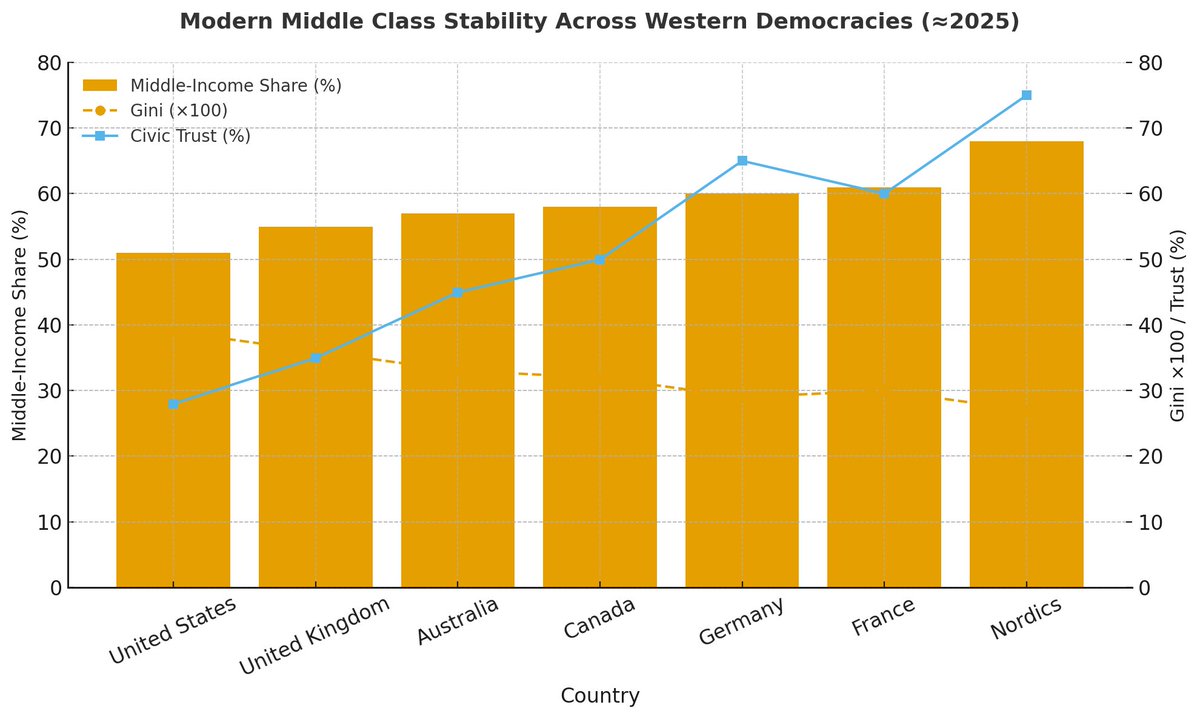
Which is why it lurches between tyrannies, of the rich and poor. Between oligarchs and populist influencers. There’s no strong moderating, mediating middle class layer, running institutions that create democracy.
The data tells the story.
/7 https://t.co/t4nI4F3BfH
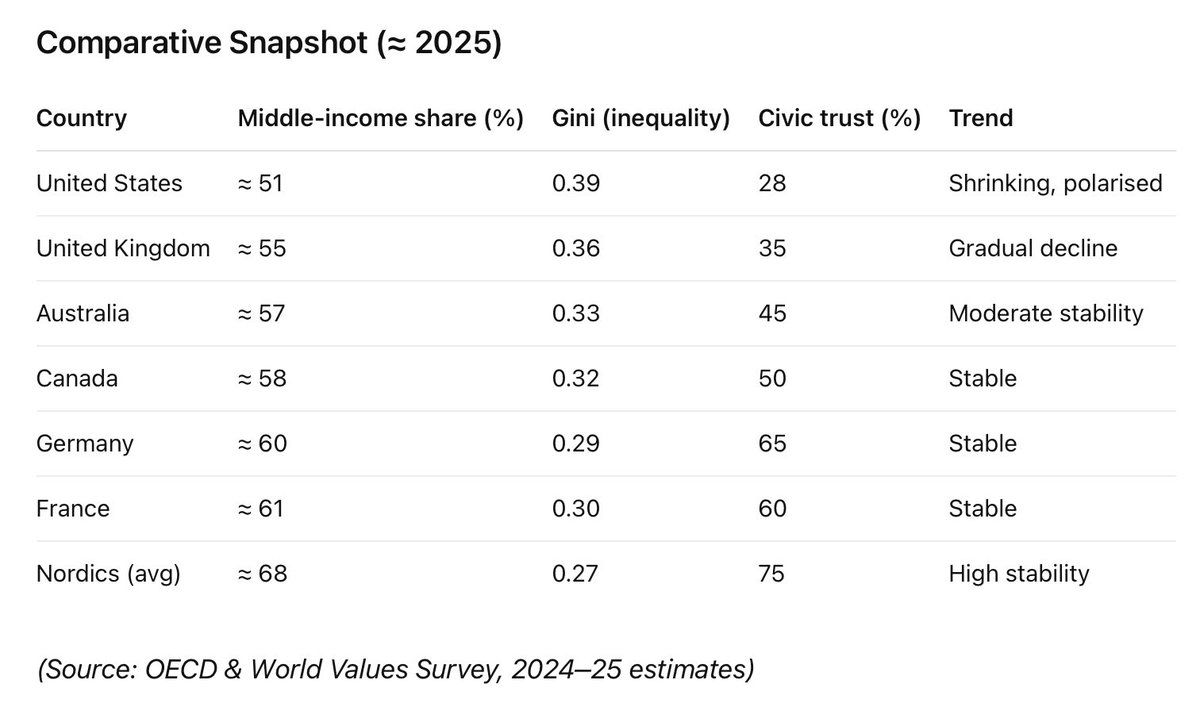
It’s plain to see here that the greater the emphasis placed upon strong institutions and a middle class to staff them, the better the democratic outcomes are.
Both the US and UK have historical hostility towards this fundamental truth. They’re both in decline now.
/8 https://t.co/YfJqeXaGrJ
I can only encourage people to not be persuaded by these idiot platforms, themselves mostly of US origin, into adopting the cultural practices of this hostility, which we’ve seen decimate basics like climate and Covid action.
It makes societies eat themselves.
/9
A healthy democracy isn’t ’the people’ consuming vast quantities of information every day, trying to run the country themselves.
It’s those same people paying little attention to those details at all, delegating them to trusted institutions to manage.
/10
‘But the institutions are corrupt!’. You’ll hear Americans and Brits say this, because of that historical cultural hostility to institutional life. (The Brits don’t even have a written constitution.)
Or others will evoke failures of things like public health, in Covid.
/11
Those failures were engineered, and have been since the 1970s, with the institutions white-anted consistently as ‘red tape’ and ‘bureaucracy’, again mostly through influence from the hostile British and American anti-institutional culture.
/12
Burke knew it. Aristotle centuries before him knew it. Institutions create not only democracy, but the public itself.
The public is not and will never be ‘the people’, as just some mass of protesting folk in the streets. That’s just a mob.
/end