Pandemics are the on/off button for societies. All major catastrophes are. We talk of the health impacts, but…
Pandemics are the on/off button for societies. All major catastrophes are. We talk of the health impacts, but there’s a much deeper social, cultural and psychological impact that I think goes unnoticed. The breaking apart of illusions of group life. /1
When not challenged by natural disasters or war, things that overwhelm our standard ways of doing and thinking about things, humans live happy social lives. All of their reference points are social, they imitate one another, and form rivalries with that imitation. /2
‘I want to be noticed and accepted’ is the most fundamental human act. It generates our social hierarchies, of status and imitation/emulation. As Paul McCartney said, the lure of fame is not about being admired, it’s about being accepted for who you are, socially. Affirmation. /3
As I Tweet about a lot, this explains 99% of human behaviour. The status games of imitation, where 95% of any group desperately imitate what the 5% of ‘influencers’ say and do. It happens at school, at work, in science, in politics. Everywhere. It’s not stupid either. /4
None of us would get a thing done without this mechanism, we’d have to work everything out for ourselves, rather than TRUST others with expertise to do it for us. Trust is the social glue all of this imitative rivalry generates. But it also means dangerous things. /5
Because if you can pervert the trust process, you have total control of groups, or of whole societies. If you can develop ways to generate cheap and easy trust, you’re on the road to total power. I used the example of Tupperware parties previously, the genius of that method. /6
Where peoples’ natural distrust at being sold things was broken down by having their friends, who they naturally trust, do the selling for the company. What social media has now done to our world is made all of it a giant Tupperware party. /7
Now not just kitchenware, but everything, including basic science, has had its existing longstanding mechanisms of trust replaced with a simple process of popularity, on these platforms. ‘Influencers’ can be found for any topic. Politics, engineering, pandemics…everything. /8
This is why I’m so dismissive of the value of social media, because it’s an assault on the trust mechanisms that hold our societies together. Without properly managed trust, societies collapse. Look how quickly cookers have damaged longstanding vaccination culture in Oz. /9
You won’t find an area of life that hasn’t been damaged by this shift. It’s still accelerating. And this brings me to the deepest damage I mentioned in Tweet 1 of this thread. What this means for us, as individuals. /10
When the essential operating systems of societies are trusted, while we get on with our lives, we can have happy social and intimate relationships, safe in the knowledge that even if we disagree with those closest to us, the most important stuff is still being done. /11
But strip away that trust and therefore that enormously diverse and distributed expertise, and suddenly it really matters who not just your friends but even those you love in the deepest ways, trust to guide their lives. Their beliefs suddenly can even kill you. /12
They may buy the slogans about Covid for example being a sniffle, and recklessly infect everybody they know, repeatedly. They become a real and present danger to you, every day. No more luxury of ‘each to their own’. Our beliefs and who we trust now impact lives. /13
Directly, and sometimes catastrophically. And you then can arrive at a point where the expression ‘we’re born alone, we live alone and we die alone’ suddenly becomes clear. It doesn’t mean we stop having these friends or loved ones. /14
But it destroys what was always an illusion, that we were bound together by common understanding. We’ve always disagreed, and in love we’ve never really understood the other person, nearly all of it is a projection. But we could avoid those truths, while societies were ok. /15
Now though those illusions are falling away. People are recognising, even within their closest social groupings, their families, that they are alone. That their social ties always were compromises, not magical fusions of different souls. And not to misunderstand here. /16
I’m not saying previously we all liked and loved one another, and now these social changes mean we don’t. I’m saying that what we’ve always called friendship and love was not what we thought it was, and the social reboot of the pandemic is making that visible. /17
‘You think you know a person’, often said when somebody does something totally unexpected, like dumps you in a relationship. But you never know a person. Everybody lies, gentle lies, for social harmony. Until the social is removed, like right now. The operating system. /18
Replaced by nothing but popularity. That’s what populism means. When the only measure of value, of anything, is popularity. How alone did many feel at school, watching these popularity games from the outside? I think that’s maybe 95% of us. That 95/5 split, in all groups. /19
We never leave school now, not an analogy. Our adult culture brought high school culture across to adult life, because it’s all those who went to school knew. That feeling of loneliness and brutal judgement by peers is now much of adult life too. /20
We stripped away the old grown-up institutions and replaced them with social media platforms, whose only currency is popularity. Likes. It’s where the majority now get even their most serious news, and understanding on all things. To end then, this is the deepest cut. /21
What do you do, when the TRUTH of something is now at odds with even the people closest to you? Do you let the friendships and relationships survive, and live truths you know to be false to keep the peace? Many here have talked about the agony of that choice. /22
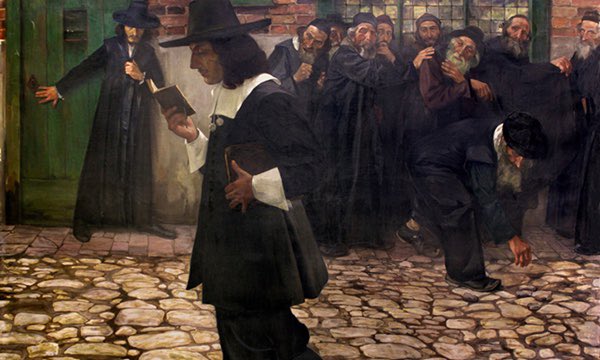
It’s why this picture of Spinoza still resonates so strongly with me, during this pandemic and the collapse of much of our hard-won social infrastructure. This was Spinoza’s life, excommunicated from his own community for refusing to bend to truths he could not believe in. /23 https://t.co/ma0FfiTrF8
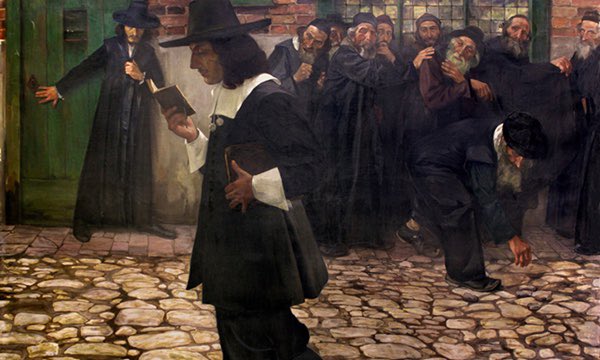
Spinoza always said that the only freedom is true understanding. He walked the talk. Like Archimedes run through by a Roman sword while refusing to stop work even during an invasion, he refused to succumb to social pressure that had gone awry. /24 https://t.co/HgIsFZjgAT
Do you let friendships and even relationships fall away, in this world of populism? I’ve let many friends go in this pandemic, their trust now captured by lunacy and a direct threat to me and my family. It’s a difficult time in history, but not unique. /end