This story is perfect to highlight what travel cultures don’t understand. We don’t know how to occupy our own…
This story is perfect to highlight what travel cultures don’t understand. We don’t know how to occupy our own landscapes. We live on them, not in them. We travel through them. We have no idea how to live with the platypus, for example. /1
https://t.co/HdFyn67KRa
We might try to make a reserve for them, or a national park, pretending the ‘natural’ world is some separate thing, ‘nature’, that we can have as a gated community somewhere, for flora and fauna. It’s the madonna-whore complex, for landscapes. /2
We either turn them into real estate or mine them for resources, or worship them as ‘pristine nature’, untouched. We don’t have the first idea how to live IN them. How to share our societies with non-humans. That’s not a ‘greenie’ thing either. /3
Most Green politics is heavily about the pristine nature nonsense. As recent research on Aboriginal landscape management shows, that madonna method of isolating national parks turned vast estates of beautifully-tended, productive landscape into dense scrub. /4
That scrub is a mess, which we idolise as ‘the bush’. In reality it’s criminal negligence. I remember scoffing at my grandmother about 40 years ago, a keen gardener, when she commented that the Australian bush looked ‘a mess’. But how spot on she was. /5
Watch this great new series on SBS for a taste of what that research is turning up. And read Bill Gammage’s astonishing book, things most Australians have not the first idea about, the wonder they’re living on, instead of in. Here’s the details. /6
https://t.co/yHHTqJp6WK
https://t.co/YRlWa9wv3y
I see Marcia Langton heaps huge praise on this book, and rightly so. To me true reconciliation will only come with First Australians when we understand the sorts of things you’ll find in this book. How they created the greatest wonder in history. /7
Modern Australia, travel Australia, is so fundamentally opposed to the genius of those First Australians, that I find it impossible to see how the two would ever be reconciled. And most countries are infected by the same travel virus, which at root is something much deeper. /8
I did a thread on that this week. We (and most Western culture) are not *grounded*. We have no conception of land, of home. To us it’s just an address, all interchangeable, all itineraries of a locomotive culture that always moves and never arrives. /9 https://t.co/V5dW5teXfV
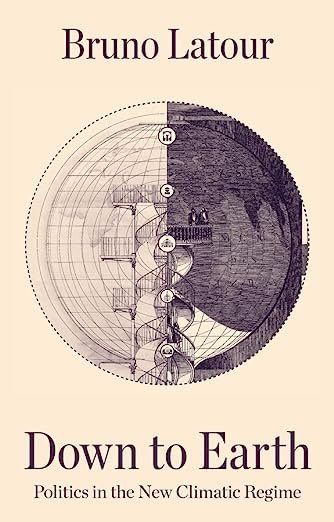
Bruno’s Latour last work was about this. How societies need to learn how to ‘land on Earth’ again. Like a plane lands, the wording is precise and deliberate. How all of our political headaches have their root in this absence of rootedness. We have no relationship wth space. /10 https://t.co/zaMocRIJvC
We travel through it, we accumulate it as ‘sights’, as tourists. Travel is central to the culture, its most visible manifestation. We travel so much because deep down we feel that lack of groundedness. It’s like a cry for help, feeling that accumulation of sights will fix it. /11
Our own homes don’t do it for us. We’re endlessly restless there, not at ease. We refuse to just BE, anywhere. We need a constant diet of ‘experiences’ (of other places) to sate our anxiety. Not stopping to think that the wonders we go to see are wonders because somebody…/12
…*inhabited* those spaces. Made them into the wonders they are. They had a RELATIONSHIP with space. They tended it, loved it, enriched it, for generations. Our own suburbs are mostly just car parks for business. Nobody travels to see those. Houses 1-7 in this random sample? /13 https://t.co/9RnVHnBz8j
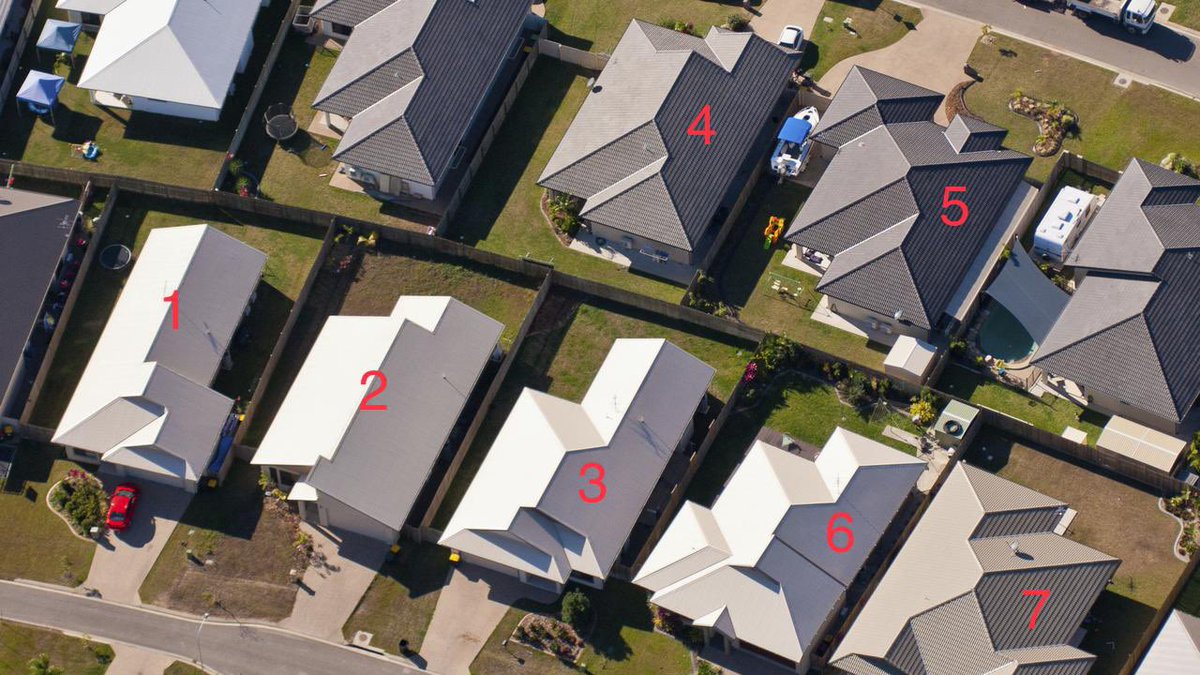
Likely the people occupying those work for completely different businesses, spread far and wide across the landscape, with no unifying thread linked back to where these people are living, only metres from each other. That’s ‘the economy’: dislocation, dispossession. /14 https://t.co/kWdP2QbraI
The fancy name we give to our actual culture, of eternal displacement, dislocation and dispossession. Even within nations now you’re lucky to even have one of these suburban homes for your commuting car, the dispossession continues internally. Community is about land. /15 https://t.co/M4UjA6mrLO
Not real estate, that’s economy-land. About the land you occupy, and the entities you occupy it together with. And not just people; the flora, the fauna, the water, the minerals, rocks. The lot. Not a ‘return to nature’ either. There is no nature, it’s a myth. /16
No hippie living ‘at one’ with nature either, because there is no nature. It’s about actually inhabiting landscapes again, working them, which doesn’t mean giving up modern technologies or comforts, but about integrating those back into land, into community. /17
From inside economy-land, the tiniest progress is being made on this by talk of ‘circular economies’. But its a much deeper, existential thing at stake than recycling. It’s about finding our true homes again, our grounding in existence itself. /18
To stop using space as recreational playgrounds, for travel, and to inhabit it again, to enrich it, make it beautiful. As Gammage’s book wonderfully describes, Aboriginal Australians ‘farmed’ in a way we simply can’t fathom. They used no fences. /19
Instead they enriched the landscape, to make it attractive to both flora and fauna. Then they accessed some of that rich resource for their own use. Everybody won. Everybody had a beautiful home. None of that territorial economy-land, fencing in stock for personal profit. /20
I go on about travel because again it’s the symptom of a much deeper malaise. That malaise is the root cause of pandemics, climate change, and pretty much every other intractable problem we have. 135,000 planes in the air every day, 400 billion litres of jet fuel every year. /21
Nobody is landing. Make that a new verb. Land-ing. That’s the shift we need. /end