One of the weirdest and deepest misunderstandings in all human thought is the distinction between big and…
One of the weirdest and deepest misunderstandings in all human thought is the distinction between big and small. Scale. The prejudice that says big things are complex, small things simple. Covid thinking is like this. The bacterium MO-1 is a good stating point. /1 https://t.co/2pw5WVLuwZ
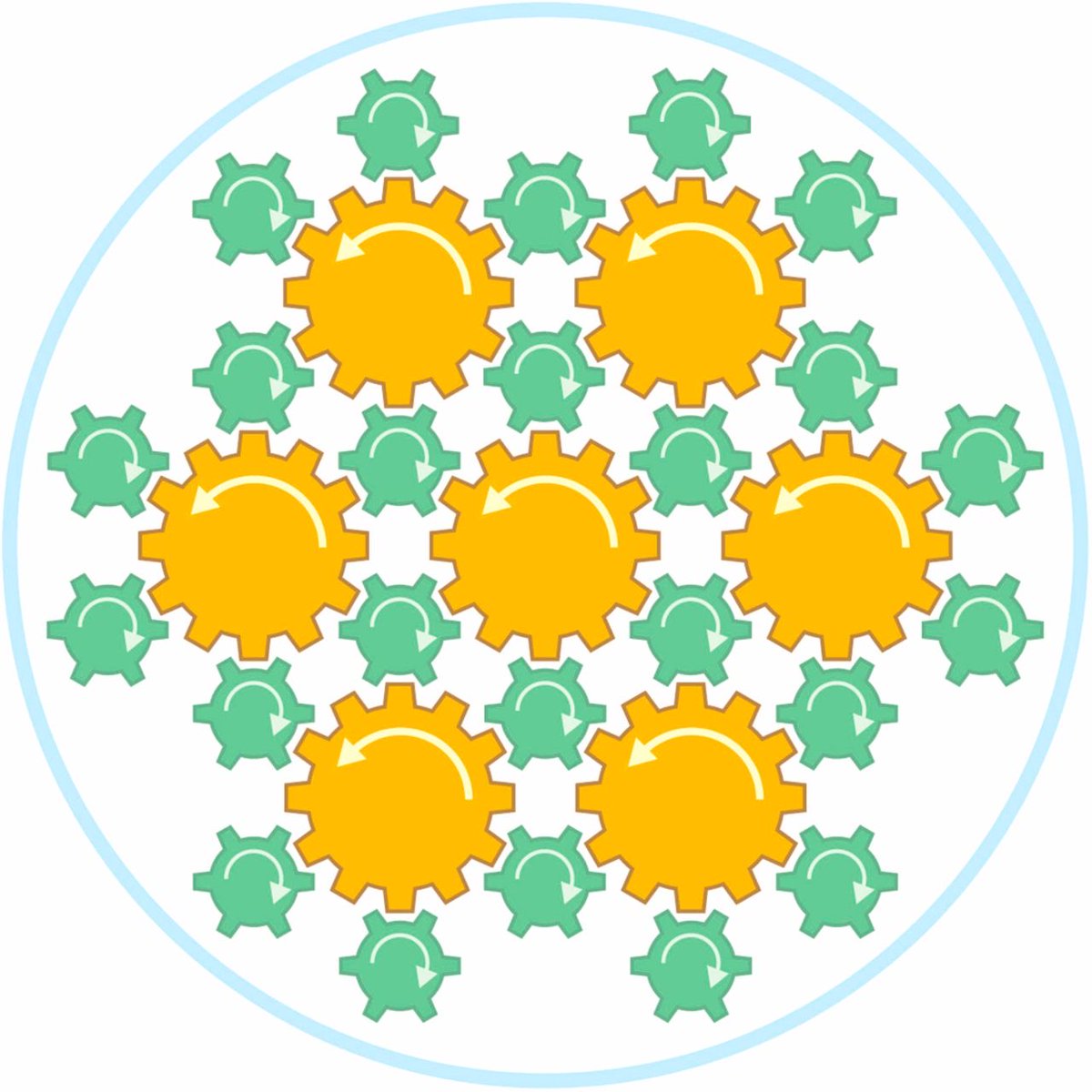
MO-1 is a magnetotactic (orients itself along field lines of the Earth's magnetic field) bacterium with an exquisite supramolecular motility machine to move it along. That's what this diagram shows. There's a tight bundle of 7 flagella (yellow) and 24 fibrils (green). /2 https://t.co/Uhq6Z8Y1mg
All encased in a sheath (blue). The flagella and fibrils rotate anticlockwise and clockwise, respectively, to minimise friction at high speed rotation. Extraordinary engineering. But the wider point here is the prejudice we have that says small things are simple. /3 https://t.co/WVBHF12Tk8
So micro-organisms are thought to be more simple lifeforms than macro-organisms such as ourself. (Of course we'd think that.) And a century or more of atomic theory, where atoms are seen as simple building blocks of larger more complex things, suggests the same. /4
But it's wrong. Incredibly this prejudice survives, despite nearly every empirical example proving the opposite. Micro-organisms like MO-1 have breathtaking complexity. And atoms after quantum theory are mind-bendingly complex, unfathomable things. /5
Zooming out to human societies, you can see this even more obviously. What 'macro' thing (an organisation, an economy) comes even close in complexity to any of the individuals that make it up? To make big things, you SIMPLIFY little things. Dramatically. /6
Humans in an organisation or even any group lend just the tiniest part of their extensive individual complexity, to that group. Their complexity as a person far exceeds any of the 'macro' characteristics of the groups they're part of. /7
We say that individual cases are 'anecdotal', and only complex aggregate patterns tell us what's really going on. Or that economies have macro and micro components, and only the macro is the 'big picture'. /8
But not only is this backwards - the small is always *more* complex than the large. There is also no small, or no large. (Bear with me.) An example, any modern nation. Our prejudice says the nation is the aggregate sum of all the individuals living in it. /9
Added together, like Lego blocks. But spend two seconds on this idea and it all falls apart. What Australia thinks about the Voice to parliament for example is not 1/25 millionth my bit, added to millions of other bits to form a whole. Any Australian has a *whole* view./ 10
Not 1/25 millionth of a view. The referendum will of course count our choices, but they don't add up to whatever the Voice ends up being (or not being). It's a binary choice between two *whole* or 'macro' views. Maybe easier to see with a crowd. /11
We attribute a 'macro' behaviour to crowds, like the people in them all follow some highly simplified script. But they don't, look at any photo of faces in a crowd, like this one from Alex Prager. Each person is doing what they're doing, for their own individual reason. /12 https://t.co/h5LnjcufgR
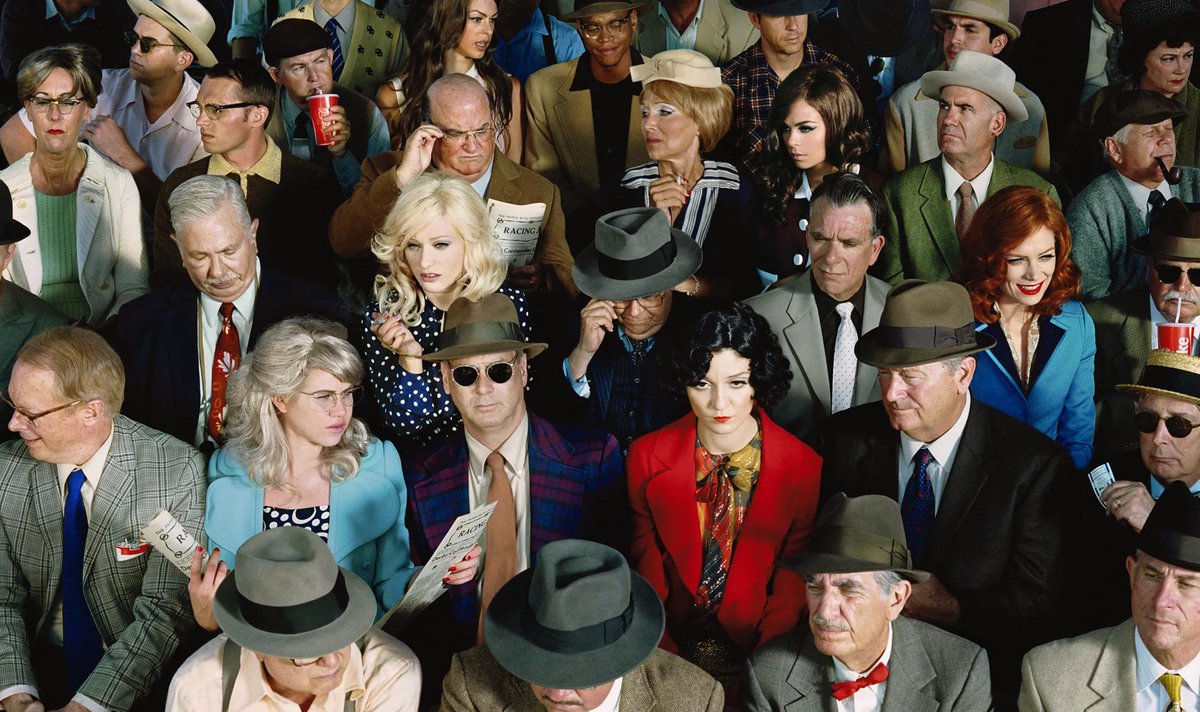
An individual reason that includes their entire global/macro view of how the whole world works. Not a tiny partial fragment of a worldview. An entire worldview. Each contributes to any 'emergent' behaviour for their own individual reasons, shaped by that whole view. /13
That individual macro choice is made at each moment, based on their constant re-assessment of what's happening, from inside the entire 'macro' worldview each has. I'm hoping it's clearer how micro/macro is a myth (but the prejudice is very deep, so maybe it's not). /14
When all of these individuals combine to produce an outcome of some form, it's not not now some separate 'macro' entity, made up of lots of little micro entities. Every individual is doing a macro assessment the whole time, the distinction isn't real. /15
The 'whole is greater than the sum of the parts'. Rubbish. The parts aren't summed at all, this isn't Lego. Each whole is a provisional dynamic achievement. Made by individuals, but thinking 'macro' things. There's no binary here. /16
Similarly when we all speak a language, the words are universal and individual *at the same time*. I didn't invent English, but when I use it the meanings are already universal the moment I say or type a word. I may do other threads on this, it's a tricky topic. /17
But to finish with Covid, and micro-organisms in general. Macro-organisms are likely created by micro-organisms acting a bit like people do in a crowd. All lending just one part of their expansive characteristics, to that organism. We're societies of microbes. /18
More on this later.../19