Something that Covid shows so well is that modern societies who thought they had a base of certainty from…
Something that Covid shows so well is that modern societies who thought they had a base of certainty from which to act, science, have nothing of the sort. Like everything else in life, all truth is contextual. Bertrand Russell’s parable is a way in to this topic. /1 https://t.co/20ZKKymcv6
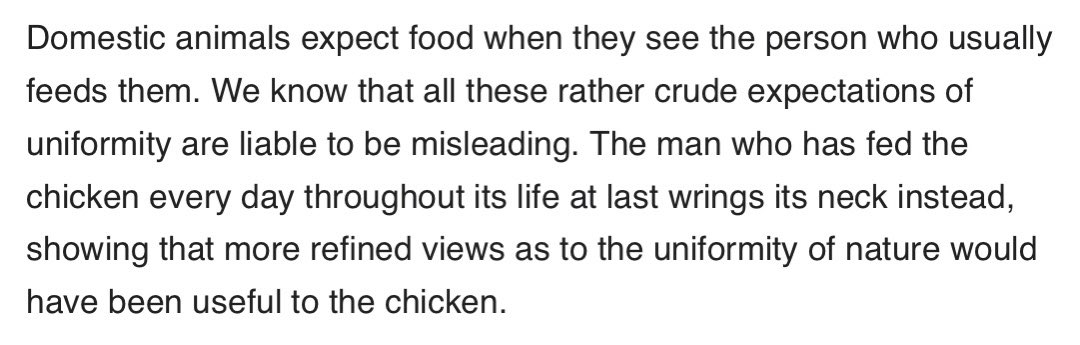
Russell is talking about the ‘problem of induction’ there, something Hume most famously discussed in the 18th century. Induction is the bedrock of science, so in many ways it’s quite astonishing that centuries later his challenge is still unknown by many./2
The idea that we can infer what will happen, from what has happened before. The sun came up in the East every day of my life, so it will again tomorrow. These people look after me (chicken), so I’m safe with them (wring my neck and then eat me). Hume demolished induction. /3
(Worth noting that Einstein attributed some of his key insights on relativity, to Hume.) In any case, for a long time it’s been known that science doesn’t create the sort of certainty we think it does, it’s not its job to be the ultimate arbiter of things. Another more recent…/4
…exploration of this was the famous Duhem-Quine thesis, that it’s impossible to provide a definitive experimental proof of anything, because all experimental set-ups are themselves made up of layers of auxiliary assumptions and hypotheses. Contexts. /5
It was the Enlightenment which desperately wanted science to play this ultimate arbiter role, replacing God. Hume destroyed the idea while the Enlightenment was still underway. But it hasn’t stopped everybody from scientists to politicians falsely using science in…/6
…this arbitration role since. ‘We’re following the science’, in this pandemic, for example. Which turned out to be doing what the person saying it wanted to do, and cherry-picking science that seemed sympathetic. And then just ignoring the science completely. /7
To be clear, the problem of induction and Duhem-Quine’s work do not in any way invalidate science. They invalidate the idea of it being the ultimate arbiter of truth. And this is where our current Covid situation struck me again yesterday. I saw some research suggesting…/8
…that live virus (attenuated) vaccines not only work against pathogens, but have a much greater positive health effect against a range of other infections as well. While vaccines not based on live virus in fact increased mortality risk (the research says) for some groups. /9
Quite an explosive finding. When I see something like that, the first step I take is one I’m sure many take. Rather than try to reason-out the logic and results in the first instance (something I’m not qualified to do, in that field), I tracked the social network that…/10
…this researcher engages with. That gives us an immediate indication of what ‘universe’ or context the ideas are living within. It helps us assess how much we can trust the result. In this case, anti-vax and ‘natural infection’ folk had flocked to these findings. /11
Which isn’t unexpected, to them they’d be dynamite. That in itself doesn’t invalidate the claims, plenty of researchers have all sorts following what they do, for their own reasons. My next step is to assess the degree of engagement of this researcher, with this extended…/12
…social network. If they’re just being discussed at arm’s length, it suggests they’re bystanders and builds trust a bit in their findings. But if they’re actively engaged in the social network, prosecuting claims about natural infection across a whole range of contexts,…/13
…including in political contexts separate to the research, then a seed of doubt is sown, for me. It’s motivated research, the auxiliary hypotheses Duhem and Quine talked about come into play, the context of assumptions the researcher has taken into their work. /14
And those assumptions are the *actual* bedrock of societies. Not facts. Societies are created and maintained by social conformity, by trust, not by rationality. Or rather the rationality in play is to assess degrees of trust, which is an intrinsically social process. /15
All of the positions on Covid map a particular social network *precisely*. And again, this doesn’t mean truth is anything goes, and only the most powerful win etc. It means that the battles we see between different scientific ideas are not battles over the truth of…/16
…particular concepts and data. They’re battles between entire worldviews, the framework that in turn creates the layers of auxiliary hypotheses and assumptions that Duhem and Quine talked about. We rarely talk about these worldviews, each pretending to be talking only…/17
…about ‘the facts’. But no fact exists without a context, without a framework of assumptions. If we could actually talk about those underlying frameworks, we could make progress. What I try to do, when pointing out the entire pandemic is really the creation of particular…/18
…political beliefs about the relationship between individuals and groups. ‘The economy’ is the framework. But I’m not confident we’ll do this, because we’re always drawn back to the team sports of backing our own side, our own social network. /19
And unfortunately the greatest leader of really meaningful change is total natural catastrophe, like wars and natural disasters. Plagues. Only those can significantly re-order those ties of social conformity that create the social networks which create our societies. /end