#covid19 #auspol We've heard lots of wonderful medical and scientific expertise in this pandemic. Often,…
#covid19 #auspol We've heard lots of wonderful medical and scientific expertise in this pandemic. Often, sadly, ignored. What we haven't heard as much are voices from the public policy community. The thinking that ties it all together. A thread...1/n
A pandemic is more a social and political than a scientific or medical phenomenon. Clear evidence of this is in the vastly different outcomes in different countries, in this pandemic so far. As @billbowtell says, nature makes viruses, politics makes pandemics. 2/n
It's very clear from the example of those countries who achieved local elimination of the virus that this was an achievable outcome, and not heavily dependent upon scientific or medical expertise. These were public policy successes. 3/n
Had all countries pursued the same strategy, it's arguable the pandemic would never have occurred. The dictum if all you have is a hammer, then everything begins to look like a nail, is playing out in expert opinion, with expertise arguing contested ways out of the pandemic. 4/n
We saw this in the debates around 'balancing' public health action against economies, a nonsensical framing driven by politicians, journalists and some economists. Beating the virus saves economies, there's no binary. The 'opening up' narrative continues however. 5/n
Having rejected the mitigation strategy adopted in much of the rest of the developed world, to great success, Oz now is lurching towards reframing its current public policy response against that global response. I think this is dangerous. 6/n
The great desire to have a vaccine to 'end the pandemic' (still a common narrative) seems to have thrown strategic caution to the wind, with countries now falling all over each other in a league table race to vaccinate quickly. Often the wrong countries. 7/n
With the 'vaccine apartheid' (WHO term) currently underway, developed nations seem determined to end the pandemic at home, and get back to 'normal' life. But normal life - gig economies - was the main cause of the pandemic. 8/n
Countries unable to take on the most basic act of sheltering from a threat, because of just-in-time economic processes. As Sir Richard Barrons has said, developed countries now have almost no resilience to major threats. And we call that 'normal'. 9/n
Australia now flagellating itself for being slow to roll out vaccines. Adopting the urgency from those parts of the world who in 2020 failed miserably to do even basic virus control. Driven by the re-emergence of the most lethal 'open up' variant in public policy. 10/n
Australia is not a fortress. Goods still flow across the borders. People less so, due to a (public policy) refusal to build dedicated quarantine facilities. Throughout the pandemic lack of basic planning worldwide is evoked as a reason to not do basic public health work. 11/n
To give public policy perspective, the (supposed) collapse of international travel in the pandemic actually just returns the world to the level of travel it undertook in 2004. Our old normal is the problem here, trying to prise apart strong public health strategies. 12/n https://t.co/26XM8v3CYD
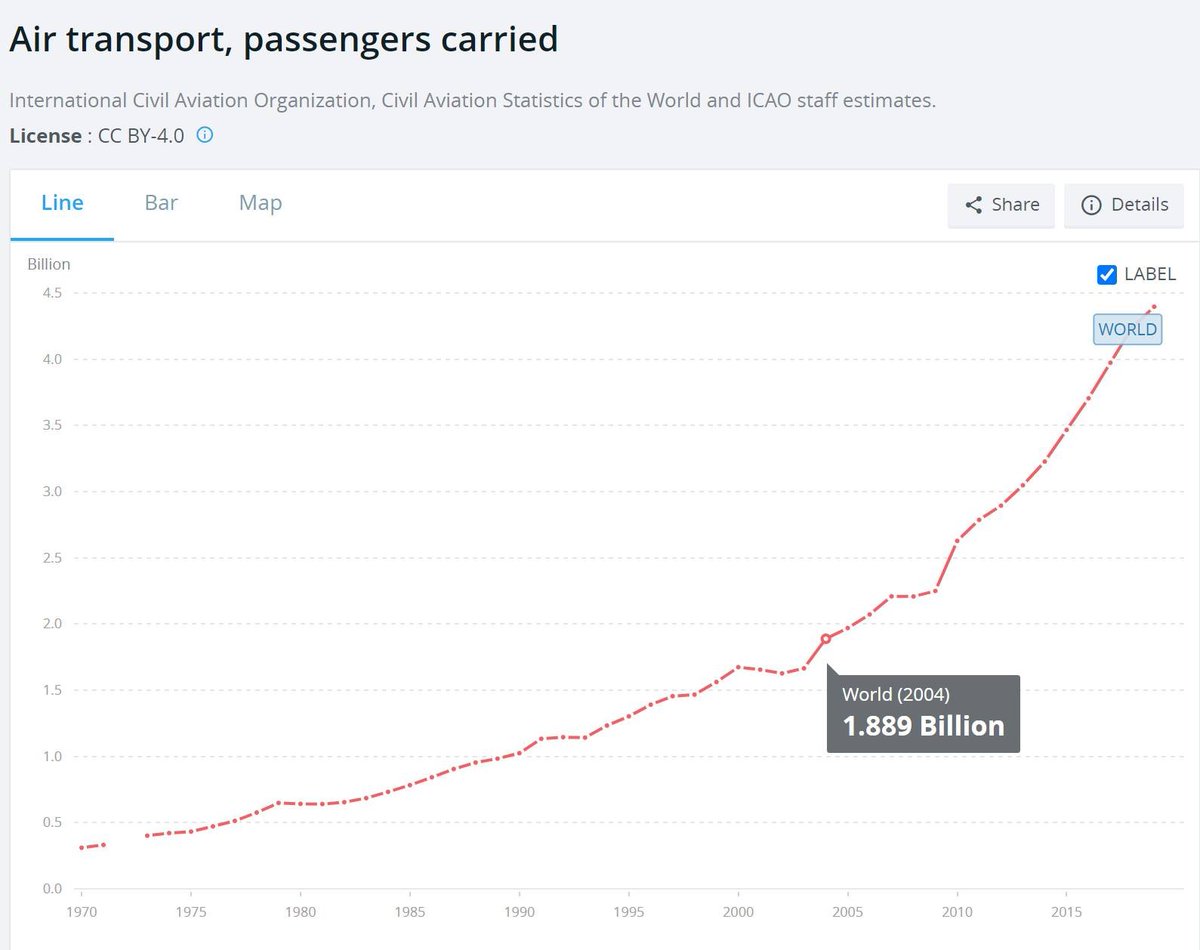
From a public policy viewpoint, countries like Australia and NZ already 'ended' the pandemic. It's the rest of the world now scrambling to catch up, leaning very heavily on vaccines. It's dangerous for the antipodes to gauge themselves against this First World first aid job. 13/n
One not mentioned possible strategy is for Oz to simply wait until the rest of the world has the virus under control, closely approximating the situation already lived here for most of the past year. 14/n
We need to rigorously test the assumption that the rest of the world is now on a fast-track back to 'normal', and Australia is being left behind. The global pandemic statistics are worse now than at at any stage of the pandemic. 15/n
Rich countries who have vacuumed up world vaccine supply in their desperate first aid operation are now delusionally talking as if the end of the pandemic is in sight. They should not be our guides. Should the vaccines fail, they still have almost nothing to fall back on. 16/n
The Oz public (who have persistently pressured for strong public heath action) unsurprisingly now want the highest efficacy and safest vaccines, and are being told the few months of waiting required for mRNA jabs for all will place the country at enormous risk. 17/n
Why? Australia faced the virus when no vaccines were available, and was able to maintain elimination. Now if we don't all rush out and get vaccinated by tomorrow, all of that will stop working? The variants of 'open up' are active again, driven by business groups mostly. 18/n
If there are further outbreaks in the meantime, Oz knows what to do. But does it still want to do that, or has it surreptitiously now adopted the open up variants continuously reactivated by vested interests in rich countries? 19/n
We need to rigorously challenge the economic framing of this pandemic. Australia's 'Economy' is actually booming right now. We can't have everything international travel adds to that Economy, but much of that was also the least resilient parts of it. 20/n
Foreign students, for example. Universities only became so reliant upon them through many years of funding cuts. Fix the funding cuts, the problem dissolves. Tourism dollars often flowed overseas, away from starved industries here. Etc. 21/n
So much of the urgency right now is driven by the old status quo, desperately trying to reassert itself. It shouldn't be allowed to succeed. 22/end