Dunkelman traces how nation-building institutions now struggle to build anything at all. We can easily list…
Dunkelman traces how nation-building institutions now struggle to build anything at all. We can easily list those who obstruct this building work, like the sponsored small government movements that are really about entrenching established power.
But, there’s more…
/1 https://t.co/jIITpaSsqU
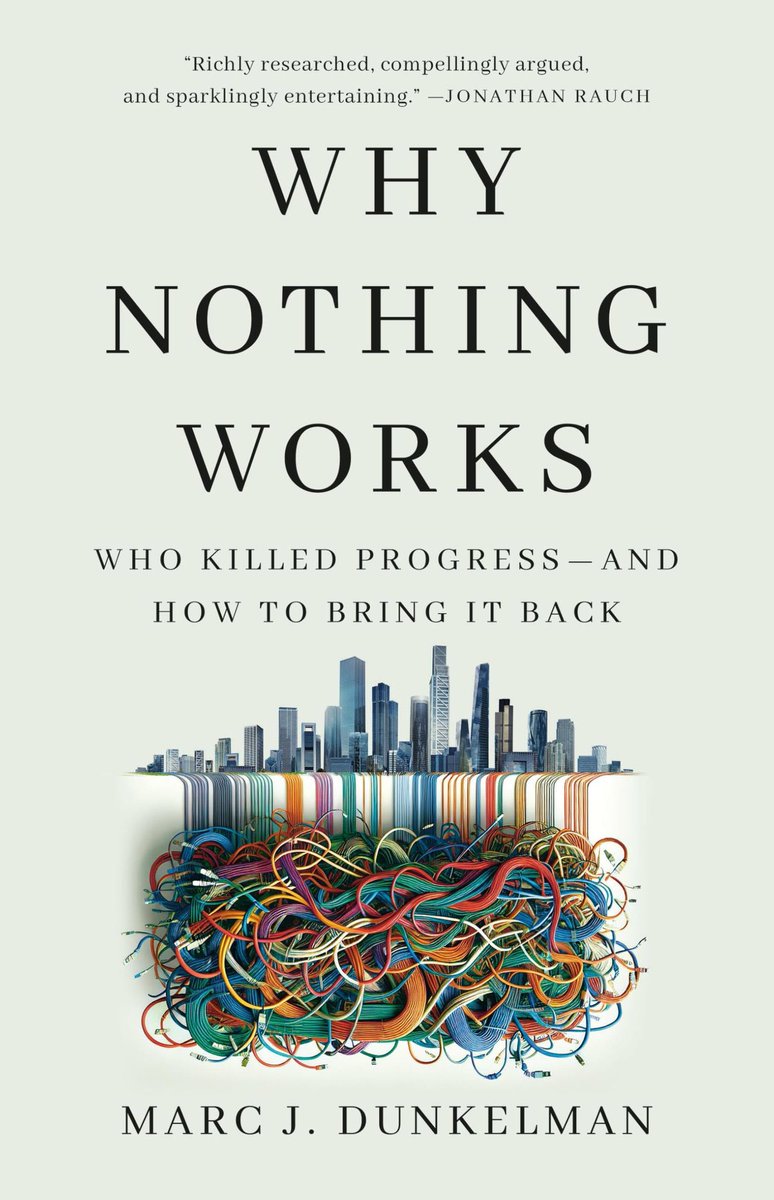
Dunkelman points out that it’s often progressives who also lead the obstruction, by their longstanding campaigns against centralised power. Their demand that power be held to account.
Combined, this led to the emergence of a ‘vetocracy’. A wonderful concept.
/2
A generalised power of saying ‘no’, to everything. Of veto, from an explosion of interests and groups.
Why this happened is where I think we can go further than Dunkelman. He talks about proceduralism overpowering outcomes.
/3
But from the point of view of status and punctuated equilibria, the central mechanisms in all human life, this shift is something more profound.
The institutions that actually built things emerged in response to crisis and catastrophe. They were REPAIR jobs.
/4
They created a ‘we’, a continuously calculated optimum to guide their work. Targeted at collective good, sanctioned by their repair of catastrophic destruction of social life. Wars, natural disasters.
Once they achieved the repair, the battle for status returned.
/5
That’s where the vetocracy emerged. Where social groups, in rivalry with one another for status, obstructed any widespread coordination of effort.
No collective can function or even exist, without crisis. Without crisis, humans just fight for status.
/6
Now collective problems become platforms for status games. We saw it with Covid, we see it with every public issue now.
Nobody is really interested in working together to resolve issues. Issues fuel their rivalries, with other groups. They LOVE rivalry.
/7
What I’ve always called the ‘team sports’ model of human life. Because it’s the same mechanism, forming teams, competing with other teams for the ‘win’.
Elections are the same. People ‘win’ elections. The idea of governance being a ‘win’ is intrinsically perverse.
/8
But we don’t spot it, because that imitative rivalry - the team sports status games - is the deepest human activity.
We always default to it, in the absence of catastrophe or crisis. Fighting other teams for the win in social status games.
/9
Only the near total destruction of life itself can break the hold these status games have upon us.
The chokepoint of proceduralism Dunkelman talks about is a midpoint on the passage from a collective ‘we’, to a battling ‘I’, that Robert Putnam talks about.
/10
Where individuals and groups shift from working towards a collective ‘we’, targeted towards survival and repair in response to catastrophe.
To a fight for their own status and identity, in the absence of this collective work to define it.
/11
Their greatest weapon in this fight is the general obstruction of other groups and individuals, in their fight for status.
The generalised power of saying ‘no’. The vetocracy.
Not coincidentally also what toddlers and adolescents do.
/12
They have limited power to change anything. But they can resist, they can simply refuse.
We live in a kidult culture, which I Tweet about often. With its origins in compulsory schooling, setting up a divide between child and adult life.
/13
And when children started to vastly outnumber adults - the boomer boom - adult life was over. All of society became a perpetual high school.
A culture of continuous rivalry for status. A giant schoolyard. Now embedded in social media.
A culture of likes and followers.
/14
A culture of just saying ‘no’.
And building nothing.
/end