McLuhan tried to teach us that the ‘medium is the message’. That first we make tools, and then our tools make…
McLuhan tried to teach us that the ‘medium is the message’. That first we make tools, and then our tools make us.
The escalating apocalyptic narratives of social media made me remember this. Those narratives are symptomatic of our capture by the medium.
/1 https://t.co/v8F5PPSImS
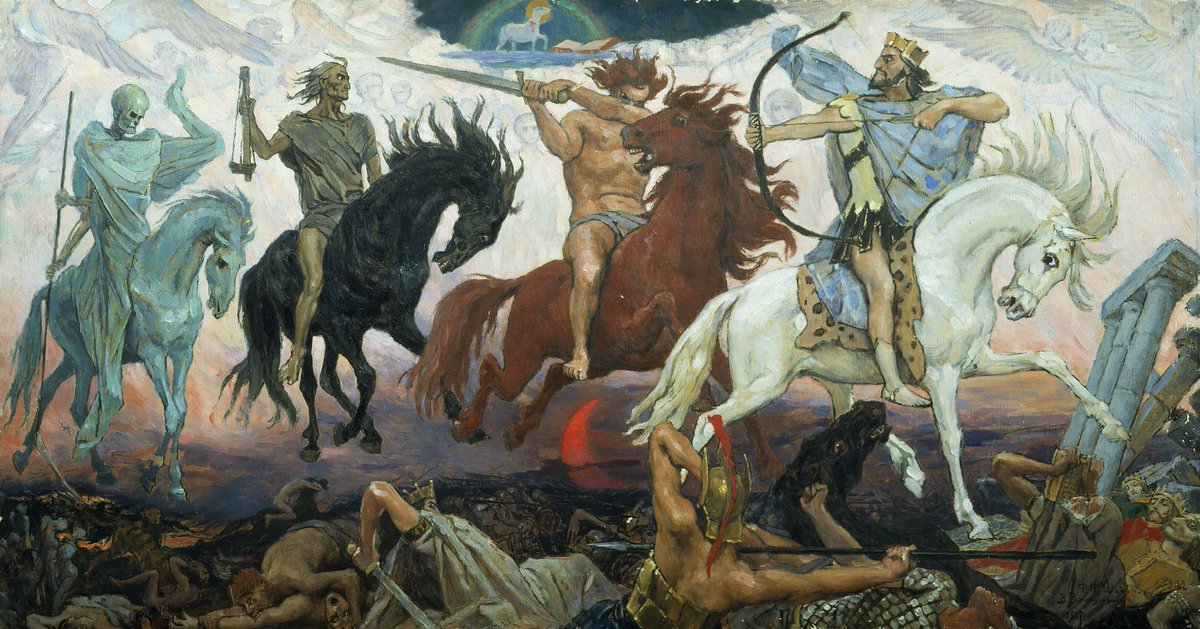
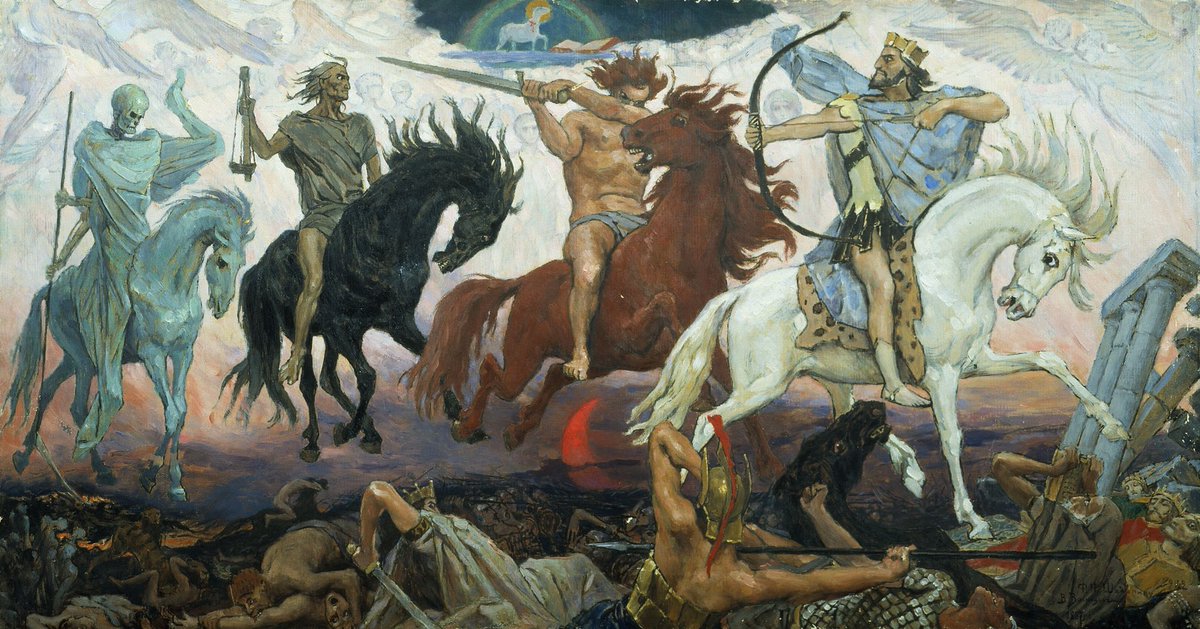
Vasnetsov’s Four Horsemen of the Apocalypse, from left to right - Death, Famine, War, Conquest - capture a lot of the vibe of daily Tweeting.
If you had to assign a genre to Twitter, it would probably be ‘apocalyptic’. So what’s going on here?
/2 https://t.co/RQbPkremjm
Thus the term ‘doom scrolling’, though this isn’t about personal choice, seeking out apocalyptic themes. The medium intrinsically generates doom.
This is also not some toxic positivism saying ‘things are really fine, stop worrying’, as the minimising status quo often says.
/3
Things are absolutely not fine, societies are at a critical juncture right now, points of real danger. It’s more about how you deal with those critical junctures in history.
Let me suggest that apocalyptic wallowing only intensifies and extends the problems.
/4
For example, I’m still recovering from my first Covid infection. I took every precaution for 5 or so years, and the fucker still snuck through.
The posts I skip most often now, in recovery? The ones describing the apocalyptic impact of Covid on our health.
Why?
/5
Because I already knew Covid was terrible for us, it’s why I took all of those precautions. Right now it’s not helpful in recovery to read about how doomed we all are.
What are people hoping to achieve, with those apocalyptic narratives?
/6
Those who read the science don’t need convincing. Those who don’t aren’t listening anyway.
I’ve Tweeted many times that societies don’t run on facts, and they won’t start either by describing the facts apocalyptically.
This is where the medium infects us.
/7
Girard pointed out in his mimetic theory that imitative rivalry drives all human activity. And that hierarchies develop to short-circuit this process, to calm and suppress rivalry.
Institutions. Expertise that is widely accepted and allowed to act, rather than debated.
/8
We’ve just lived through half a century of gradual dismantling of most of our institutional framework, through populist politics.
Societies now pile onto social media platforms, which have becomes where social life itself is now transacted, personal-professional-political.
/9
There is no DISTANCE on these platforms. Everybody is supposedly equally relevant. Those who can generate likes can generate visibility, and stand out from this ocean of indifference.
Nobel Prize winning experts are easily outplayed by adolescent influencers.
/10
Imitative rivalry is uncontrolled, in the battle for likes/status/visibility. In the absence of material institutional separation between levels of expertise, symbolic competition becomes existential.
Everything becomes conflict. Every conflict feels like TOTAL threat.
/11
Apocalypse is rivalry stretched to infinity. Who can outdo the other in end-of-days stories.
At the same time Peter Turchin describes how we live in a time of the dramatic proliferation of rivals for elite position. This dramatically intensifies the rivalry.
/12
These rivals mobilise narratives daily to try to get ordinary people as ‘followers’, in their battles against elite rivals. Apocalypse has always been a great mobiliser.
Turchin’s insight. Where societies look chaotically ‘divided’, it’s really something else.
/13
A relative tiny handful of elite rivals, whipping populations into apocalyptic frenzies to try to outdo one another in imitative rivalry, to rally more troops to their respective teams.
Social media is the battleground in 2025. Many of these rivals OWN the platforms.
/14
Symbolic capital substitutes for institutional power. Apocalypse functions as elite differentiation.
The prophetic voice, ‘I see what others deny’, replaces formal (institutional) authority.
‘The system’ is rotten! Etc.
/15
Again, things ARE badly wrong right now, civilisation itself is at stake. But apocalyptic rivalry doesn’t fix that, it accelerates the collapse.
Because it comes from the same mechanism causing the collapse. Our tools (social media) have re-made us and blinded us.
/16
Societies collapse always for the same reason. Because of uncontrolled status games between elite rivals.
Status runs societies, not information or facts. You have to target status, to control it, to fix problems.
/17
Status must derive from actual knowledge, knowledge focused on fixing collective problems.
Embedded in institutions that are relatively impervious to point-in-time whims and rivalries, for status. That are humanity acting in TIME, not space.
Creating continuity.
/18
Sadly institutions generally arise (you can’t just create them) as repair mechanisms for the catastrophic destruction of societies by uncontrolled status games, or external threats.
Like those post-WW2 that gave us historically unprecedented peace and prosperity.
/19
Sadly status games tend to have to break things completely, for this repair to emerge. And sometimes it doesn’t, most civilisations expire, they become extinct.
But recognising this objective social mechanism can really help, today.
/20
If we dropped the hubris that any of us have control over much of existence, and that forces beyond us tend to determine outcomes, as they do in evolution, much of the rivalry could fall away.
It’s irrelevant who wins status games. Reality always decides outcomes.
/21
Calm, empirical, material facts of life put us in contact with that reality. Not rivalry over who speaks for the facts.
A politics re-worked as ‘just fixing material problems’. Sans detours through ideologies and other rivalries. Fuck all that Left and Right BS off.
/22
Stop thinking arguing with other people is the route to anything except more argument with other people.
Just fix things. And help others do the same.
/end