Trump’s Venezuelan action continues a long US tradition. Which was a Roman tradition. The US has always led…
Trump’s Venezuelan action continues a long US tradition. Which was a Roman tradition. The US has always led the modern world in these actions.
Regime change abroad is about managing elite rivalries at home, as it also was in Rome. Everything is always status rivalries.
/1 https://t.co/cuAH7eUQn9
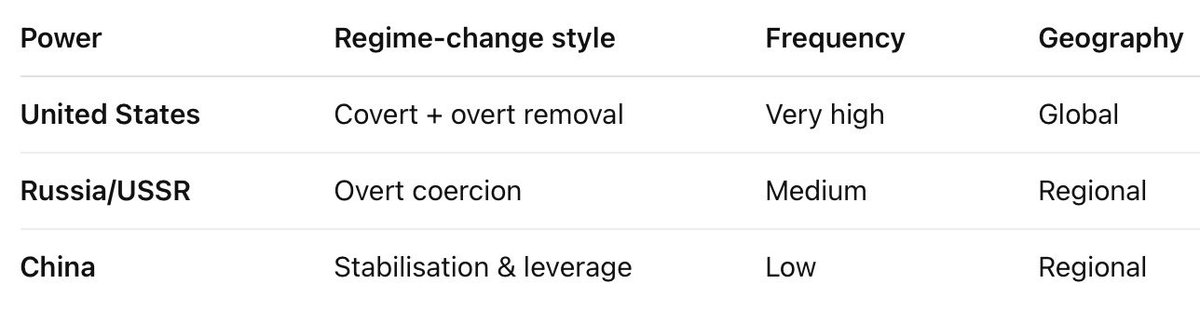
The Russians in modern times do the same, though at less than half the frequency of the US, and mostly contained to their own borders.
US regime change ambition is global. China a fascinating exception, but is still about managing elite rivalries elite rivalries at home.
/2 https://t.co/vVzJOjsFXQ
Why does foreign regime change manage elite rivalries at home, in the US and Russia and much earlier in Rome? Because none have/had effective mechanisms to maintain domestic elite rivalries.
Foreign action dramatically expands opportunities for domestic elites.
/3
Using @Peter_Turchin’s model again, elite overproduction domestically leads to social instability. Foreign regime change adventures expand opportunities for domestic elites, both during the action and subsequently.
It opens up new territories for these elites to govern.
/4
We’ve seen historically how Kings and emperors use conquest as a way to bestow new land and position on their elites. To appease domestic rivalries.
That same mechanism continues today. American foreign military action enriches US elites and gives them new opportunities.
/5
The same is true for modern Russian elites, though again at much lower frequency and more regionally-contained, than for the US. Since 1945, here are the rough numbers for overt and covert regime change actions:
US: 60-80
Russia: 25-35
China: 5-10
Why is China so low?
/6
China still must focus on the same core issue in history, the management of elite rivalries at home. But it does it differently.
It generally uses dynastic succession at home, to put a broom through existing rivalries and create opportunities for rivals.
And…
/7
…it has some other internal mechanisms to manage elite rivalries, such as its civil service examination system, which regulates access to elite positions. As well as its Party structures.
China’s foreign actions tend to target foreign elites in a support way.
/8
To try to sway them towards Chinese interests, through monetary, military, industrial, aid and other support.
This is often not dissimilar to the covert action the US for example takes in foreign affairs, often under Democratic administrations.
/9
China acts in time, internalising its elite rivalry control mechanism, turning the crises these produce into managed succession mechanisms.
The West and Rome act in space, using expansion to try to create new space for their domestic rivalries.
/10
The key point is these are all homegrown rivalries. It’s always about managing elite rivalries at home.
What looks like attempts to take over the world are really about creating space at home, between competing elites. Trump’s team is so overt that it becomes obvious.
/end