I sometimes get accused of being anti-democracy. But my position is that there are no ‘systems’ of government…
I sometimes get accused of being anti-democracy. But my position is that there are no ‘systems’ of government in the first place.
Societies are not systems. They’re humans, acting socially. Then labelling this behaviour in a variety of ways.
/1
Like ‘Left’, Right’, ‘capitalism’, ‘socialism’. ‘authoritarianism’, ‘democracy’, etc. etc.
To me all of the -isms and political categories are just names of teams, in a continuous battle for social status. They’re all doing exactly the same thing.
/2
All fighting for social status for their team. Humans are a species with some very simple characteristics. The idea that they splinter into a bewildering array of distinct ‘systems’ is fantastical.
Occam’s Razor. It’s much more sensible to address human commonalities.
/3
If the teams want to call their status-seeking something, like capitalism or socialism, or Left or Right, good luck to them.
It’s still just status seeking. They just want to be pre-eminent in society, like everybody else.
/4
And they all reproduce the same outcome, despite their systems beliefs. They reproduce hierarchical social systems, with a king at the top.
That king may be called something else. We can even pretend it’s ’the people’. But functionally, it will always be the same.
/5
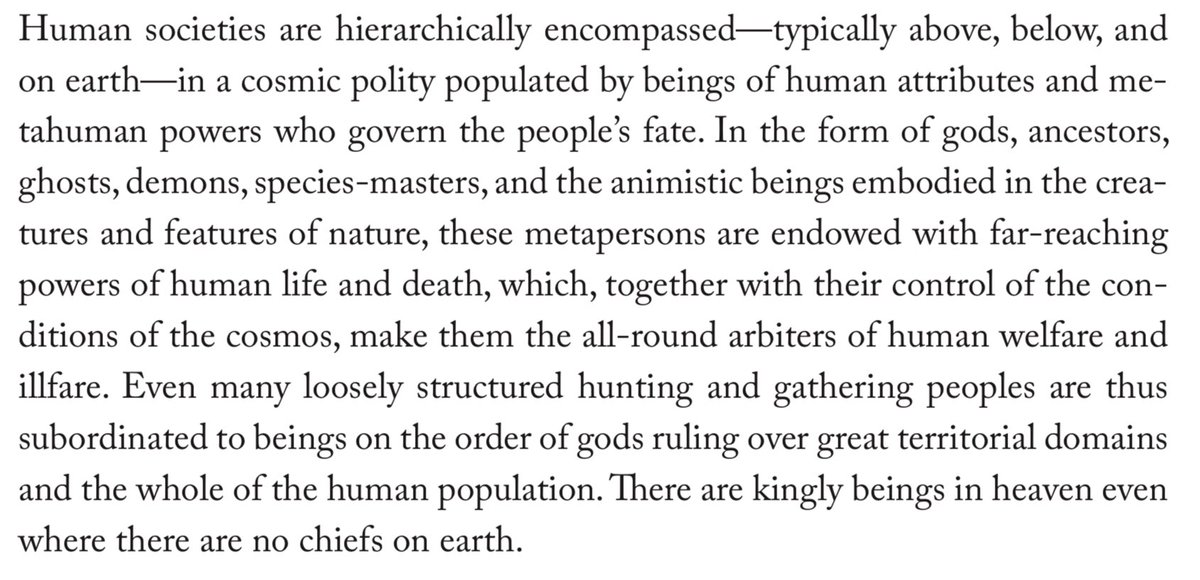
I was re-reading Graeber and Sahlins’ wonderful book on Kings on the weekend. A short passage gets right to the heart of what I’m saying here.
There it is. Always hierarchical. And that hierarchy descends from a god or ‘meta human’, through a king figure.
/6 https://t.co/6lGAJBmtVG
Humans are social animals. Social animals operate via status, it’s the most fundamental currency of their thought, belief and action.
Because status is also identity, for a social animal. It makes you somebody, rather than (literally) nobody.
/7
The wallies who ride under the banner of ‘Left’ and ‘Right’ every day are affirming their team, and thus their identity.
It’s tempting to think it matters which team wins, because of the different belief systems the teams espouse.
/8
It’s irrelevant, because what always wins is the battle for status. No matter what team wins at a particular point in time, what remains constant is the ongoing battle.
Their belief systems are branding. They have no empirical reality. Their beliefs are just trending.
/9
The empirical reality of most societies, when you look, is mostly the same. The same sorts of public infrastructure, the same material necessities of life, solved in mostly identical ways.
Material, empirical reality is indifferent to human status games.
/10
As victory shifts between various teams, they attribute progress against material problems to themselves. But such progress is completely distinct from all of the teams.
The team sports use material reality only as a venue for more status games.
/11
Why I often call for a ‘reality-based politics’, where our collective lives are focused only on the solving of material problems facing societies.
Status games mostly won’t allow that. They will insist the fight for the right to attribute progress to their team is vital.
/12
It’s a completely unnecessary detour. There are no ‘Left’ roads and bridges and water filtration plants, just as there are no ‘Right’ hospitals and schools and cars.
The social teams use all of that material progress only as fodder for status games.
/13
If you think this is idealistic, look at the Roman Empire. Yes it had status games, but more profoundly it put engineering at its centre.
It prioritised progress on the material conditions of life. Victorian England did the same.
/14
Mostly by giving status to the engineers and reformers who were focused on the material realities of human life.
You can’t be free of status games. But you can direct them towards material realities.
/end