The more we socialise human life, the more unequal the outcomes will become. This contrasts with our common…
The more we socialise human life, the more unequal the outcomes will become. This contrasts with our common assumptions about sociality, that it’s a type of leveller.
An experiment in the early 2000s demonstrated this in a novel way. Status rules societies.
/1 https://t.co/yYs4iL73c7
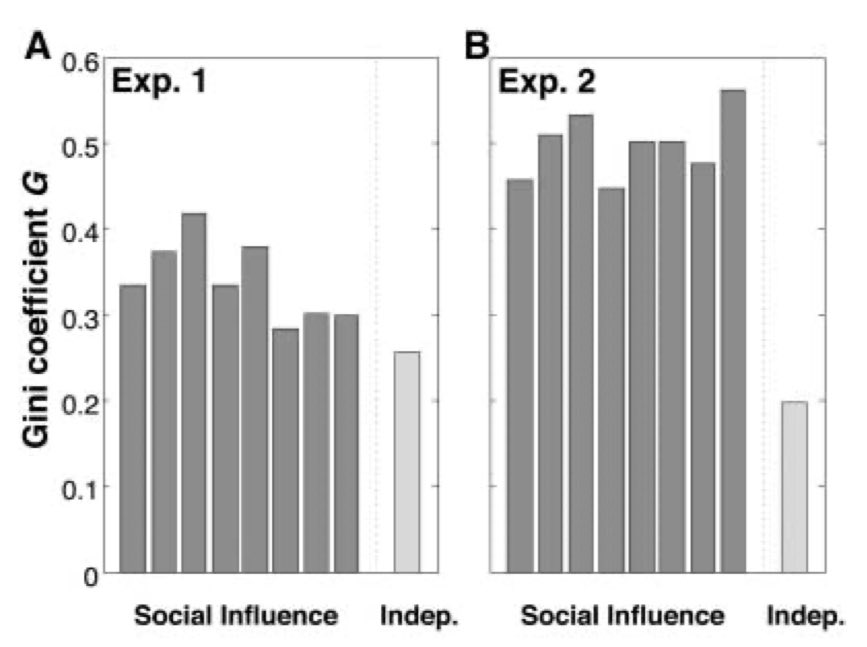
Salganik, Sheridan Dodds and Watts (https://t.co/9kBy4ZGtld) set up two distinct ways for a large group of students to assess unknown musical tracks.
One allowed only individual judgment. The other allowed that judgment to be informed by what others had liked.
/2
Where the participants had some data showing the preferences of others for the unknown tracks, much greater agreement occurred as to which tracks were ‘good’.
The Gini coefficient showing a subsequent much greater inequality of outcome i.e. some tracks dominating others.
/3 https://t.co/8Oc091lS5U
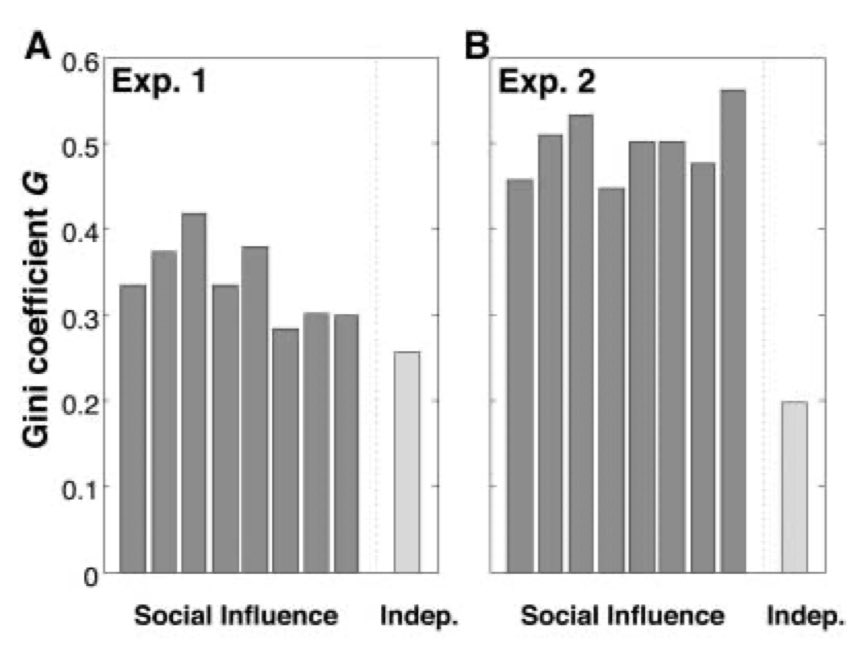
Ponder that. Almost universally it would be assumed that peoples’ taste in music is ‘subjective’. But you can see clearly that taste is driven overwhelmingly by social influence, where the group can see others’ preferences.
The research had another fascinating twist.
/4
The more participants could see what others had ‘liked’, the more *unpredictable* what counted as a ‘good’ song was.
In other words, the more the decision was socialised, the more there was a disconnect between any objective measure of quality, and success.
/5 https://t.co/3uDhyVnEqO
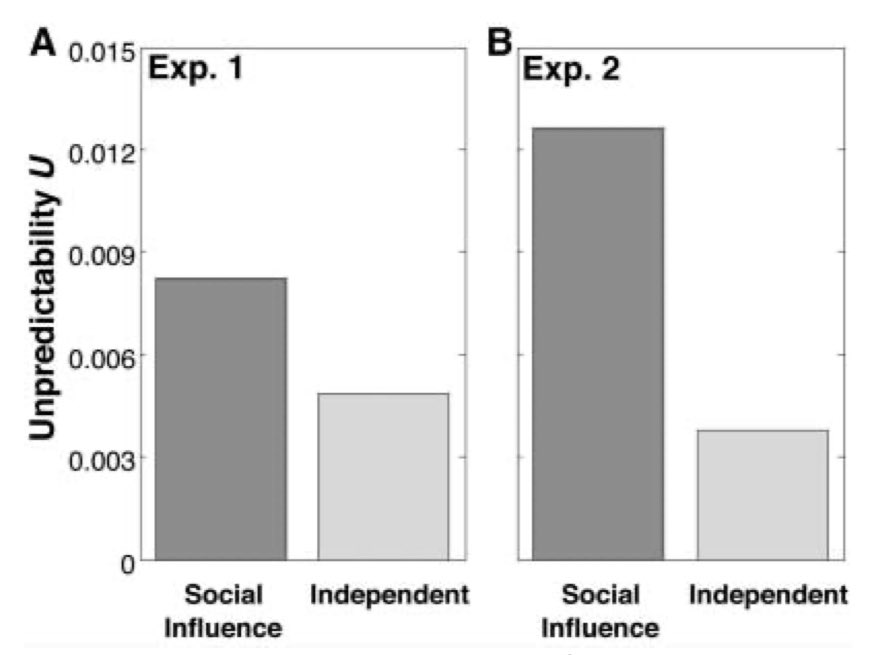
Clearly in the socialised condition, ‘likes’ were driven by social status. Objectivity itself became that status.
And status of course creates hierarchies. Thus the greater inequality of outcomes, in the socialised conditions.
/6
Status runs societies, and creates inequality and violence if unchecked.
A society that socialises its core social transactions, as we do by shifting them increasingly onto social media, will become ever more unequal and violent.
/7
Our personal, professional and political lives are increasingly occurring inside social media. It’s not a communications technology, it’s a social technology.
We’re living inside it. And it’s tearing our societies to pieces as a result.
/8
Trump is the social media President. His dismantling of institutions that have been the autonomic nervous system of societies for generations is generating nothing but inequality and unpredictability.
Fads and fashions, what’s ‘trending’ replaces public policy.
/9
Socialise everything and any objective measure of sanity and quality will be sacrificed to great viral waves of popularity. To what’s trending.
You won’t find one area of public policy where that isn’t the new norm. Trending driven purely by the pursuit of social status.
/10
Unless we understand and address status, we’re lost. Not by getting rid of it, that’s impossible. Status is also quality.
But by engineering our societies so that what attracts status is also that which promotes the collective good.
/11
As Victorian England did, with its Republic of Letters and celebrity engineers and scientists, developing the things we’re now losing - public health, transport and education, for example.
Those were high status activities, in the 19th century.
/12
Now supplanted by whatever ‘influencers’ can get to trend on the socials.
Trivialities mostly, and violence between social teams battling for status.
/end