I sometimes post about casuistry, case-based reasoning. The genius human invention that is misunderstood,…
I sometimes post about casuistry, case-based reasoning. The genius human invention that is misunderstood, neglected and forgotten.
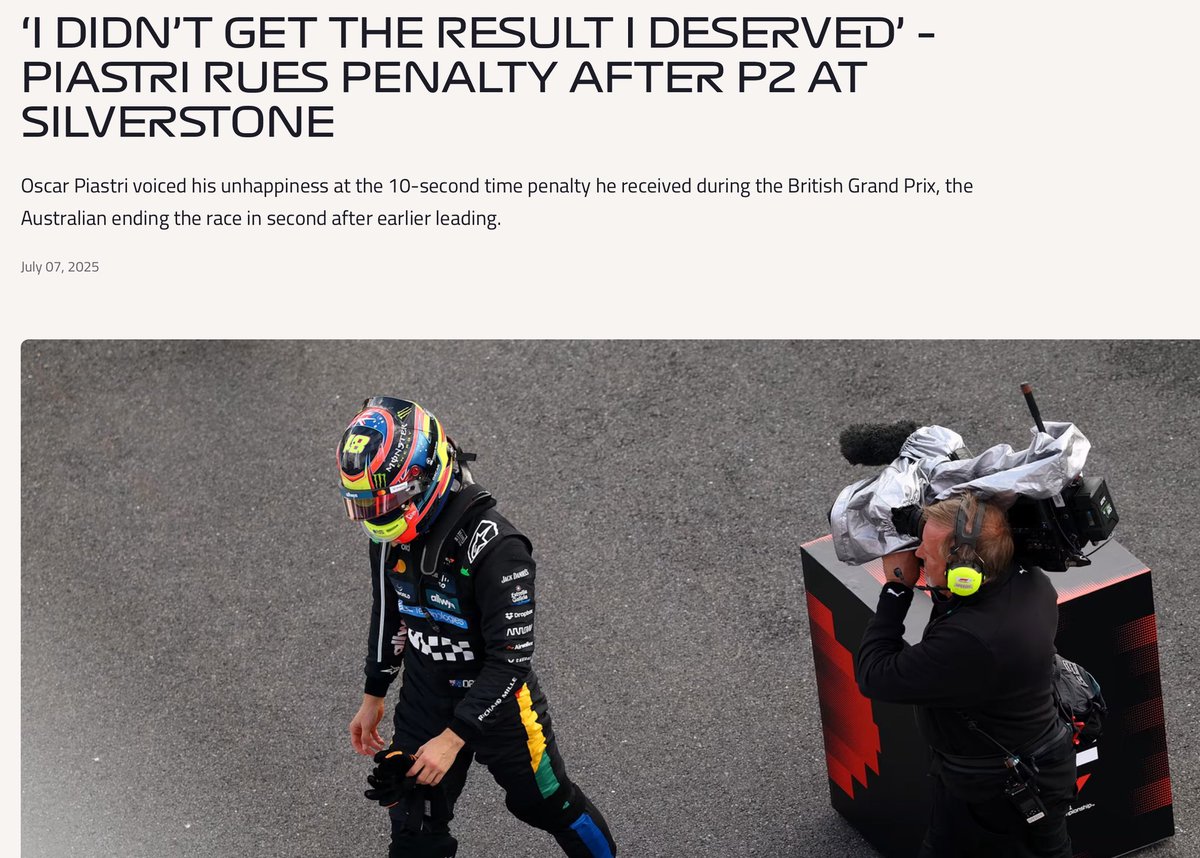
The outrageous injustice meted out to Oscar Piastri at the British Grand Prix is a great way to explore it again.
https://t.co/l7MvN8uAAg
/1 https://t.co/ngdNZkfy5p
Casuistry says that you must assess each case (of anything) on its merits, when applying pre-existing rules, laws or precedents.
It’s a fundamental foundation of law itself. It has extremely profound implications that are rarely noticed (see further down the thread).
/2
In this case, F1 has a rule about what Piastri did, that says if you do X, the penalty is Y. The problem with that is the same problem mandatory sentencing has in law outside sport.
It’s fundamentally unjust.
/3
Without consideration of context and an overall assessment of the justice of the specific case, injustice is inevitable.
If you get a negligent driving charge on the road, the penalty can be a whole range of things, depending on the context and an assessment of justice.
/4
If you hurt nobody, you will likely get a fine and lose points off your licence. If you hurt another person, the penalty will be modulated accordingly to something more serious.
This is what judges do, they add that casuistic modulation to justice. Why populists hate them.
/5
In Piastri’s case, a penalty should have been applied, but the mandatory sentencing dumb regulation approach refuses to consider the context, which in this case meant stripping him of a race win.
That outcome was fundamentally unjust.
/6
The dumb application of a blanket rule, sans context, leads to fundamentally different outcomes depending on the context of the case. There was no way the infringement should have cost Piastri the entire race.
“But the rule says X = penalty Y”. No context, no justice.
/7
A 10-second penalty *in that specific context* also meant stripping him of a race win, the same penalty applied at another time in the race, to Piastri or another driver, would have meant much different outcomes.
Regulations must be applied using a casuistic approach.
/8
What case-based reasoning discovered was something much more profound, which is also why it works.
Humans for their entire history have struggled to reconcile the specific and the general. The universal and the particular. The micro and the macro.
/9
Casuistry though does something breathtakingly wonderful with this age-old chestnut.
It rejects it entirely. It says the distinction isn’t even real. It says the universal *is* the specific, the particulars of anything *are* also the universal meaning.
/10
There is no ‘big picture’, separate to the particulars of anything. The more specific and granular you get, the more universal you get.
This upends millennia of human thought puzzles. The implications are staggeringly profound, across every part of human life.
/11
Look at what Paul O’Neill did at Alcoa, as just one example. He transformed this mega-corporation not by looking at any big picture, but by doing what every idiot MBA tells you not to do.
He went ‘into the weeds’, and stayed there. He focused on one highly specific thing.
/12
The safety of the work Alcoa did. In our ‘big picture’ thinking that seems important, but piecemeal. That’s what all the analysts thought too when he started.
He sat them on their arses. Alcoa’s performance exploded.
https://t.co/AItU1PHLkd
/13
O’Neill understood that “Alcoa” was in every tiny detail of what the organisation did. If he could find a specific everyday practice that networked with everything else the company did, he could transform everything.
Safety was that thing.
/14
Societies and organisations are networked. Find the network keys and you can transform the lot, fast and simply. This is what casuistry discovered millennia ago, in entirely different contexts.
But it applies to all of life.
/15
We have the assumption we need to aggregate an enormous number of particulars, to see the big picture of what’s really going on. That assumes society is made up of lots of separate Lego blocks.
But societies and every part of them are networked.
/16
The more particular and specific you get, the more likely you are to find the linkage to everything else. That’s where your big picture will be.
In my career I shocked everybody by shifting from a senior management position, to a much lower status position.
/17
I did it because I wanted to end my working life in the ‘weeds’. Back in the specific details of what the organisation was doing.
Because I knew that was also where the big picture was, where nobody thinks to look. In the detailed, everyday ‘operational’ tasks.
/18
Senior managers today spend most of their days in endless meetings discussing ‘strategy’ and other big picture paraphernalia.
Because we believe those are two separate things, operations and strategy. Micro and macro. But they’re not.
/19
The law already knows this. The law never reaches a big picture by accumulating lots of specific cases.
Every specific case can fundamentally disrupt the provisional big picture. The precedents. The universal and the particular are the same thing.
/end