I’ll use one of Vera Kober’s wonderful paintings to talk a bit more about imitation, the core of all human…
I’ll use one of Vera Kober’s wonderful paintings to talk a bit more about imitation, the core of all human life.
How do some smears of paint ‘capture’ a flower? How is that ‘likeness’ or imitation achieved? There’s a fundamental magic in play here.
/1 https://t.co/urZsP33D76
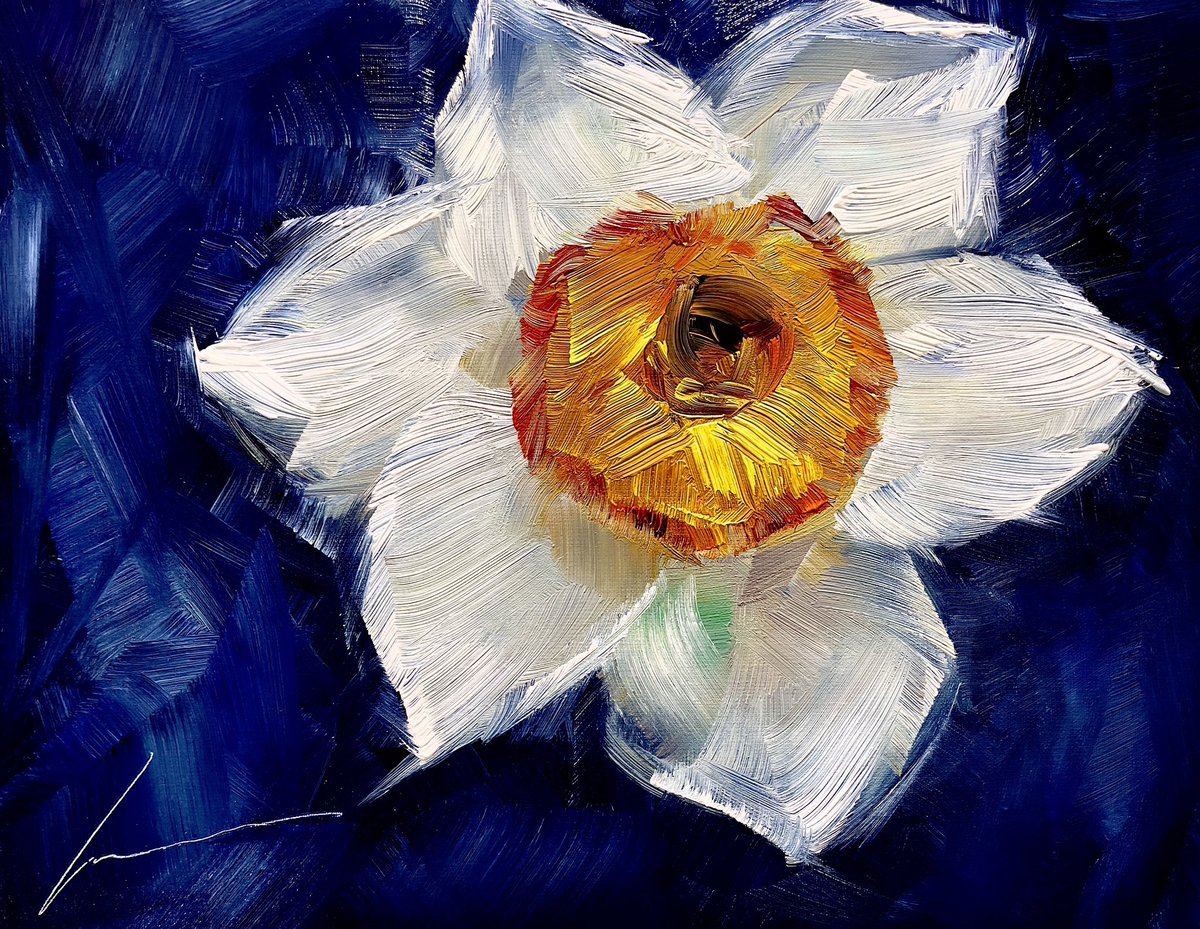
You can say the painting ‘looks like’ a flower. Very few would not see the ‘resemblance’. But we gloss over the most basic fact here.
How is it possible to detach or decouple a likeness, from an object?
/2
Paint and flowers are two fundamentally different material objects. And yet they can be made to resemble one another, uncannily.
Even more, the paint can create new perceptions of flowers that aren’t immediately obvious by just looking at a flower.
/3
That’s what brilliant art does, it allows us to see more than we could see without it. It extracts more reality, out of what it ‘represents’.
How do smears of paint and flowers end up having this profound connection?
/4
It’s important to note here that our culture today is profoundly antagonistic towards imitation. We see it as inauthentic. The ‘original’ is what matters! Apparently.
Bu there are no originals, without copies. What creates the actual concept of originality, is imitation.
/5
It’s only when copies exist, that we can make a distinction between the original and the copy. That’s when the whole framing of authenticity emerges.
Authenticity is a toxic social creation. If you unpack it, you land smack bang inside the identity politics of our day.
/6
We’re so obsessed with originality, and hostile to imitation, because our social lives (paradoxically) are now almost entirely driven by imitation.
As the collective institutional bases of our civilisations unravel under the various freedumb movements, something happens.
/7
Who we are, our sense of status/identity, becomes problematic. With collapsing social roles, that status and identity has to be made anew in other ways.
It becomes our personal responsibility. And we create identity and status always the same way.
/8
We imitate or emulate others. That gives us status in their ‘teams’ (social status groups). We become members of those teams.
This becomes an obsessive, all-consuming activity when the wider social framings of status and identity crumble.
/9
Nobody wants to be nobody. We all want to be somebody, to have a purpose in life, a place in society. We want status, and from that we get our identity.
Under the institutionally-governed relative peace and prosperity post-WW2, this was much easier.
/10
You just were a gardener, or doctor, or teacher, or road worker, or whatever. Roles attached to important social functions. You got your identity and status doing socially needed work.
Not only were you helping others, you didn’t have to curate your own existence.
/11
But the anti-institution freedumb movements have now destroyed most of that. Now social utility has been replaced with what’s ‘trending’.
Everybody now has to play imitative rivalry games, to even define who they are.
/12
Identities are proliferating, not because of some newfound tolerance for difference, but because of a genuine mass existential anxiety about an absence of status and identity.
Those identities are like psychological gated communities, for one. Violence follows.
/13
These endlessly curated identities clash with others, and so societies become endless gang warfare between rival teams.
Recognising the world today here yet?
/14
Imitation becomes the ONLY social mechanism. That’s what ‘trending’ means, something only becomes even vaguely similar to our old public policy space by trending for some length of time.
Trending is now our only social glue. And it’s toxic glue.
/15
Anything can be made to trend. The most vile equivalent of the ‘bearded lady’ at the circus comes to dominate. It’s a race to the bottom, for likes and follows.
To create and maintain status and identities for people, whose social frameworks for that have disappeared.
/16
And so here we are, in 2025, where collective life is just a series of trends. Fads and fashions. With fragile, evanescent identities attached to those fads and fashions, because that’s what drives them.
The clamouring for status and identity.
/17
So to go back to paint, and flowers. What magic allows them to ‘resemble’ one another? They’re fundamentally different material things.
It may sound New Age to say it, but it’s really just chemistry. All things partake of all other things.
/18
Things are all fundamentally unique and different, but they can resemble one another and then interact because they ultimately share a baseline potentiality, a quantum soup, from which all things arise.
Art lets us see that underlying shared material reality.
/19
Paint can be a flower (or anything else). Representation is a terrible concept, likeness is a fundamental material reality.
Those painted flowers *are* flowers. Made out of paint. Not resemblances to flowers.
/20
Similarly when we imitate and emulate in social groups, we’re tapping into a shared material foundation for human life that transcends all differences between us.
We ‘recognise’ each other, because of that shared underlying reality.
/21
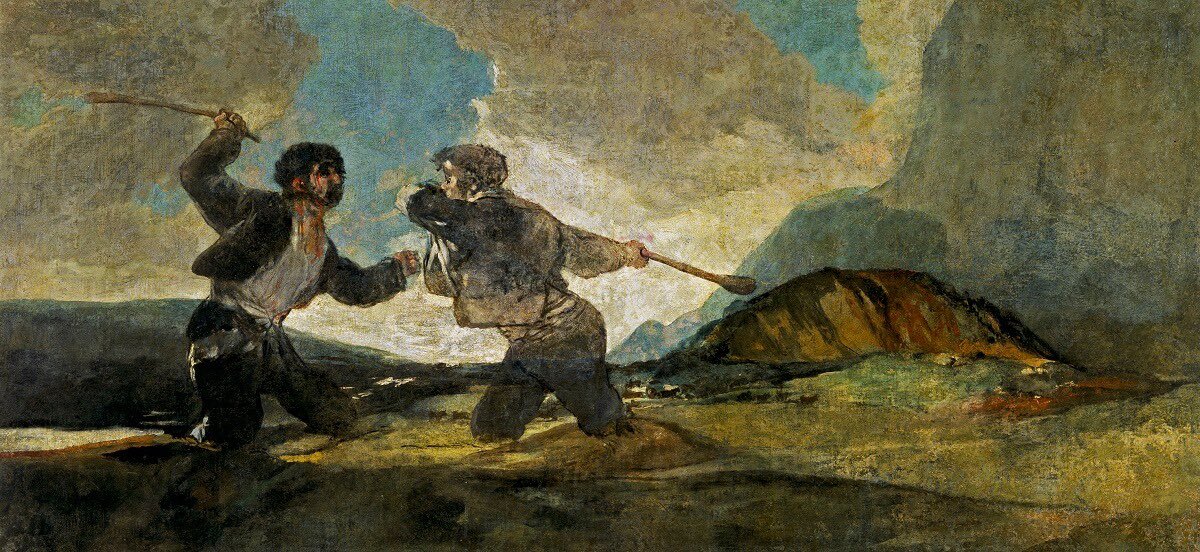
But re-route that imitation towards only your position within a human-human status hierarchy, and the material underpinnings disappear.
Humans become decoupled from material reality. What Goya was trying to show in his cudgeling humans, I think.
/22 https://t.co/Sso9pw1DfR
To imitate or emulate is divine, provided you’re emulating connection with the underlying material realities of existence.
Emulating people with the deepest understanding of and connection to those realities.
/23
Not just influencers, looking for an empire of followers and likes.
/end