Rene Girard’s passion was to understand violence. Why are humans violent to one another? People who follow me…
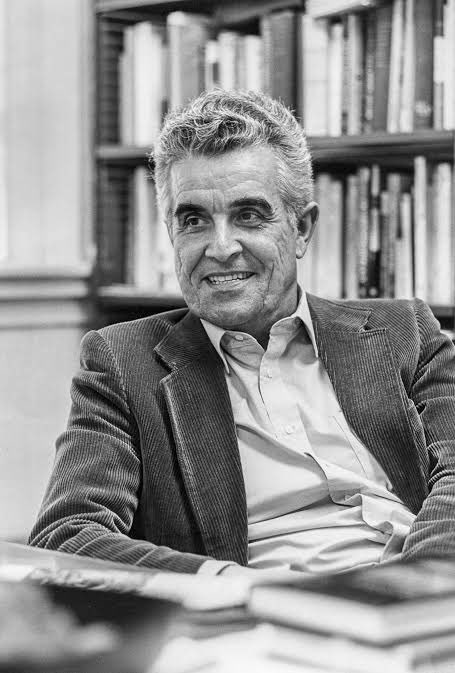
Rene Girard’s passion was to understand violence. Why are humans violent to one another?
People who follow me know what he discovered. It had nothing to do with individual human psychology or emotion.
Sociality causes violence. Humans relating to other humans, socially. /1 https://t.co/BcZpI6Ru0r
People are not stupid, people are not violent, people are not anything much at all, individually.
We are social animals. Pretty much everything we are and do is a social thing. And the most fundamental social act is imitation. We copy one another.
/2 https://t.co/0sgwoPgxwM

I remember first reading Girard and others, placing imitation at the centre of human life, and thinking, surely that can’t be it?
But it is. And the deeper you look at it, the more you’ll see. We are obsessively, compulsively engaged in copying one another.
/3
But why? The reason is more one that Gabriel Tarde explored, a forgotten genius. We imitate because we’re so different to one another.
That sounds like a paradox. Genius feels like that. Nothing is a greater hint of lack of understanding than a strong feeling of ‘a-ha!’
/4
A-ha is just a recognition of similarity between something you know, and something new. More imitation, a feeling of satisfaction that what’s new is just some variation of what you already know and feel.
And that’s why humans imitate. To try to assimilate difference.
/5
Because we are all uniquely different, to get along we need to imitate what others do, so they recognise us in some way.
We can’t ever be them or really understand them. As Tarde says, pure difference is something most never really consider.
/6
They try to tame it under some schema of explanation, that makes something new just some variation of something they already have or know.
Ah, it’s just like X! No it isn’t, but it might resemble it a bit, so by imitating X the other person suddenly feels a bit connected.
/7
That’s what social life is. We’re all charlatans, imitating to connect. And it’s here that Girard found the link to violence.
Because it isn’t X. And so that connection is always fraught, it’s always a betrayal of the true nature of X, in some ways.
/8
Our imitations come unstuck, and make others angry. There’s no faster way to mock somebody than to imitate them, it makes who they are feel threatened.
Imitation creates rivalry at the same time it causes connection. Imitative rivalry is the root of human violence.
/9
We imitate to connect, into groups, or teams as I call them, to capture the rivalry at the root of the process.
Within the team we imitate or emulate one another, in turn imitating the highest status members of that team.
/10
The team itself is therefore always unstable, and can descend into violence at any time. We’ve all been in human groups, we’ve seen that firsthand. Even a soccer club, or small group of friends.
But then it also is in rivalry with other teams. /11
And thus the ‘team sports’ begin. The imitative rivalry between teams, added to the imitative rivalry within teams, that forms them.
The battle ultimately for status. For ‘recognition’ (more imitation words). Because ultimately we imitate, to be somebody. To belong.
/12
We copy others so they ‘recognise’ us, and see us as
‘one of them’.
And there’s pretty much all of human life. Seriously, you can’t unsee it once you start looking. It is EVERYWHERE.
/13
In politics, work, science, art, which cars or clothes or food we buy. Imitative rivalry runs all of it, down to the tiniest details.
We do what we do to fit in. What gets called peer pressure with teens, but adult life if anything is even more forcefully that.
/14
But called by different names there, so not recognised. Pretty much everybody is fighting for status, within a team, and against other teams.
It creates a bubble, team sports. We stop seeing or understanding anything, outside the status games.
/15
Why I and some historians say, all that ruptures these bubbles is catastrophe. An external or even internal event of such magnitude, that the team sports are interrupted.
Wars, plagues, natural disasters. Something that overwhelms our imitative ‘it’s just like X!’ powers.
/16
Catastrophes aren’t like X. They destroy X and everything related to it.
That levels the status hierarchies, smashing them to bits. And for a while, there’s a feeling of anything is possible. Collective peace and progress.
/17
But as soon as basic living conditions are restored, the status games will start again. Always.
Because without them, as social animals we don’t even know who or what we are. They give us identity, and belonging.
/18
You can try to escape this, and succeed to some extent, but not by being a contrarian. Contrarians are even more addicted to status games, their entire existence is obsessive studying of the rivalries. Without them they have nothing.
/19
The only escape is a pretty ruthless passion for material reality. Independent of what others think about it.
That’s a very lonely, solitary affair. But it’s also a deeper connection to existence, the only real joy. As Spinoza knew.
/20
Many believe that’s what their scientific and other work is already doing. But most of it is status games, when you look.
Science is absolutely riddled with status games. All human endeavours are.
/21
To be genuinely without fear or favour is incredibly rare. Those people tend to be hated, like Germaine Greer.
Real truth tellers are by definition not popular. Popularity is imitation. They violate our very sense of identity. /22
But life is really pretty empty doing anything else, for me anyway. As Spinoza said, only genuine understanding brings true joy.
Everything else is just an imitation of it.
/end