I want to continue to openly challenge our most basic assumptions about democracy. Like the idea that…
I want to continue to openly challenge our most basic assumptions about democracy. Like the idea that sustains social media, that somehow allowing entire populations to interact is democracy in its purest form.
What can stadium crushes teach us? /1
https://t.co/3Tmyf398LA
Any event organiser knows that what separates a successful event from one where people end up dead, is intensive planning to prevent the sort of interaction we see as democracy, on social media.
Restrictions on how people interact. To prevent a crowd becoming a mob.
/2
Groups of people, of whatever size, simply don’t act as a single entity. Unless they become a mob. And then people die.
One of my main themes is to try to show how people always form status hierarchies. Any group does this.
/3
Put a group of people together, again of any size, and it will quickly stratify itself into a status hierarchy. About 5% of the group will ‘lead’ the other 95%.
This doesn’t need to be imposed externally. The group will do it all by itself, as well.
/4
Societies and sub-groupings of people form clumpy networks. The hubs are the status hierarchies.
Most of ‘society’ is empty space. It’s like atoms. With intensely focused activity in hubs.
/5 https://t.co/IqPLW3nEXn
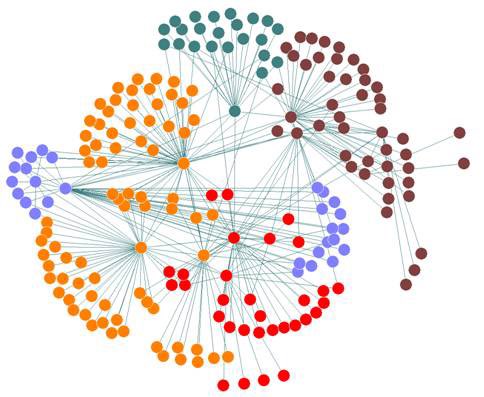
You can see this exact pattern on any social media platform. It sells itself as a glorious interaction of all with all.
It’s nothing of the sort. It’s the same clumpy network structure, with intense activity around hubs (influencers).
/6
I’ve used this network structure to also show how we were conned by Covid minimisers. Their success was to paradoxically paint Covid as a problem everywhere, all the time.
It isn’t that. Covid has that same clumpy network structure, with the hubs being superspreading events. /7
The minimiser con was what justifies ongoing inaction against the virus. Painting it as everywhere, all the time makes it seem impossible to deal with. So we must ‘live with it’, they say.
That was always bunkum, and good people fell for it. /8
Some very targeted and minimally disruptive action at those superspreading hubs could smash Covid, as it did in countries who did just that earlier in the pandemic.
It’s a puny virus in terms of spread. Easily controlled. Not eliminated, just controlled. /9
You can see here how some foundational ideas about how people (and the viruses they carry) behave can have profound impacts on how we think and act.
Similarly a literal handful of people are generally responsible for most of the destructive filth on social media.
/10
Some again quite simple, targeted action could identify and remove them. Except that would ruin the business model.
The filth drives the revenue.
/11
Democracy is not ‘the people’, as some amorphous mass. Put an amorphous mass of people together and they will trample each other to death, out of no ill will to each other.
Democracy is an administrative construct. /12
It’s what the dreaded bureaucrats do. Every day they go to work and undertake precise calculation and analysis of collective needs, in all areas of our lives.
And then they administer assistance to identified areas of need. /13
Contrast this with the truly ludicrous idea that democracy is that 3-4 yearly popularity contest we call elections.
The more we connect people, the more violent we will become. Ask any event organiser. If you don’t control connections, people die.
/14
This control, so hated by modern trust fund man-babies, is the basic stuff of adult life. No successful parent aims to be popular. No manager either. Only populist politicians.
Adult life is the saying of ‘no’. Filtering the good from the bad, and suppressing the bad. /15
Ruthlessly if required. That’s not ‘authoritarian’, the only way for populations to be free and peaceful and healthy is to regulate the fucking daylight out of them.
That’s what law and regulation is. It re-balances the inevitable inequities of uncontrolled status games. /16
All successful societies are authoritarian. You only get to choose what sort of authoritarianism you want. A nuanced one, based upon expertise and social need.
Or one based purely on unbridled status. Like Trump’s America.
/end