The most brilliant windows into our lives as humans are in the most mundane and banal stories. Like this one.…
The most brilliant windows into our lives as humans are in the most mundane and banal stories. Like this one.
I often post about how, contrary to popular opinion, our sociality and connection is actually the root of most violence.
Let’s see. /1
https://t.co/gzudMj8WGY https://t.co/XMWpd6i4LV
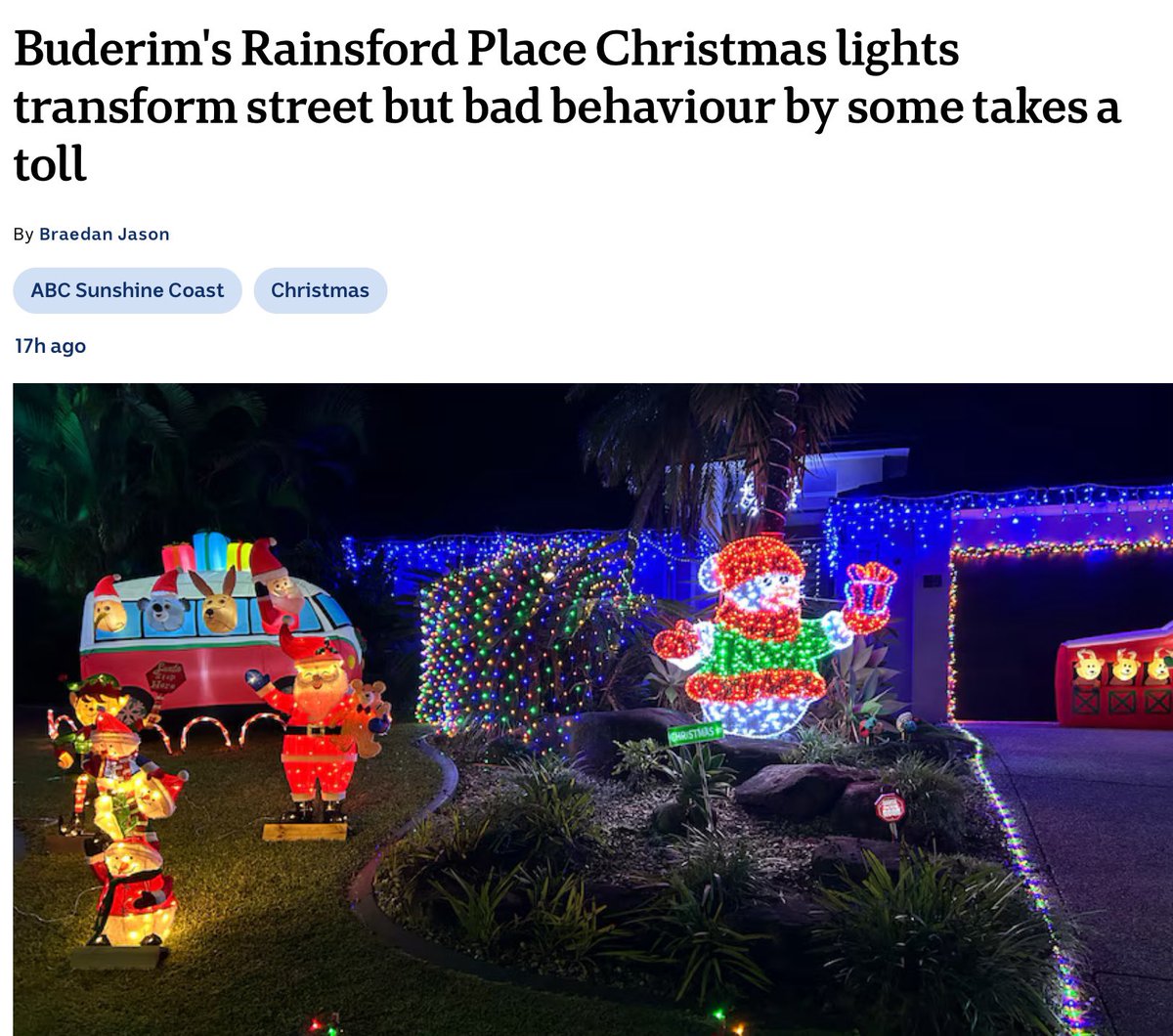
Something that seems one of those classic stories of ‘community’, people apparently making the effort to offer the community (whatever they think that means) something special.
Christmas lights. How’d that work out? /2
It worked out the way all sociality and ‘connection’ works out. Badly. Because we have not the first clue about what connection really means.
Connection creates the battles for status that I call team sports, and Will Storr calls status games. /3
Firstly, putting up Christmas lights is so often not the innocent community spirit activity it often seems.
It’s a pissing contest, so often. People compete to outdo each other. That’s THE standard pattern, throughout all history of humans living together. /4
There may be a preliminary coming together, a connection. Some activity or idea that binds people more or less strongly, in a preliminary way.
But as soon as they’re so bound, the team sports/status games begin. /5
Within the teams people compete for status, and then the team competes with other teams, for status.
And then, as in this story, the overall bringing together of masses of people into teams creates friction and conflict. /6
In this case those that throw eggs at undecorated homes, and/or their empty alcohol bottles into yards. Not part of team lights, or team ‘family and kids looking at lights’.
People who don’t feel part of either of those teams, so form their own loose coalition. /7
A team of spoilers, expressing their exclusion from the other teams.
I work in the operational running of communities. I see this all day, every day. The contrast between ridiculously idealistic ideas of ‘the people’ and ‘community’, and what people actually do together. /8
There is no default state of community, no ‘the people’. There are only battling status hierarchies, which sometimes stabilise long enough to create a sense of happy togetherness.
That’s always a fundamental lie. The more so now we have social media. /9
SM allows the rapid formation and expansion of teams, and facilitates their encounter with and conflict with other teams.
As Will Storr says, take any public ‘issue’, and what you’re seeing isn’t a play of ideas or opinions. You’re seeing status games. Team sports. /10
The eternal battle for status. Because status = identity. Without status you’re literally nobody, in a society. Completely invisible.
Vandalism like throwing empty beer bottles into Christmas light gardens makes some team visible, to the other teams. /11
I can promise you that anybody who works closely behind the scenes of keeping societies running, operationally, is neck-deep in this shit every single day.
And likely deeply cynical about the dopey idealisms of community and unity. /12
Human societies run on desires. Desires are *always* shifting, and rapidly. There is no long-term stability.
All that creates that impression historically is two things. /13
One is the cooperation forced on masses of people by their encounter with catastrophe. Wars, plagues, natural disasters, economic crashes. Those things can force most of us into a single team, Team Survival.
For a time. It won’t last. /14
Once we’ve survived and ‘normal life’ seems possible again, all of that stirring unity is ditched as fast as we can manage it.
The second is embedding our social relations into material reality. What gets called our ‘technology’ is really this. /15
Empires like the Romans or Victorian England did this, engineered vast social provision through public works, which in turn reflected back a stability upon people, who were forced to maintain this ‘infrastructure’, rather than just play status games. /16
The laughable idea social stability and social progress comes from the exchange of opinions in the team sports debates of normal times is unfortunately our default framing of most human life.
It’s complete and utter bullshit. /17
Humans don’t agree or live together as happy communities, ever. Unless they’re forced to. By the two factors I just mentioned, catastrophe and engineering.
Those who work at keeping society’s lights on know this. They’re vastly outnumbered.
Merry Christmas :)
/end