We love advocacy, ‘awareness’, ‘education’, as if the problem is other people being stupid. Advocacy is like…
We love advocacy, ‘awareness’, ‘education’, as if the problem is other people being stupid. Advocacy is like a crusade, where you get to put together a team, and fight other teams for supremacy.
And yet, the actual solution will always be some simple material thing. /1 https://t.co/Q3zgbr0aLV

ReThinkX used obesity as an example of how decades of moralising and education and advocacy achieved diddly squat.
New drugs might finally be targeting the actual problem. But what fun is that, if you can’t moralise about how wrong other people are? /2
https://t.co/6gsJDNZ0yq https://t.co/eb8YhqW6rF

As they say, the *immediate* response to that from within the advocacy/awareness framing will be ‘that’s just a technological fix’.
Technology has always been not only social, but the MOST social part of societies. Bruno Latour always tried to make that point. /3
I’ve done a lot of threads on the intrinsically social nature of engineering and technology. About how the most stable cultures in history put engineering at their centre.
/4
To create and maintain a technology requires a level of social coordination that far surpasses any approach to human life that involves people arguing with each other in battling teams.
That’s, as I always say, just team sports. It solves zero problems. /5
Many have made the case that engineers could end Covid in pretty quick time, for example. It’s not a problem of mass stupidity or capitalism or all the other team sports nonsense you read here and elsewhere.
They’ve torpedoed pandemics before, with public works. /6
If, as Ed Conway talks about in his wonderful book, we focused on the material conditions of life, most of our political problems would disappear in the pointless puff of hot air that they are.
Our politics thrives on dysfunction, because dysfunction fuels team sports. /7 https://t.co/ES6UAjqj8N
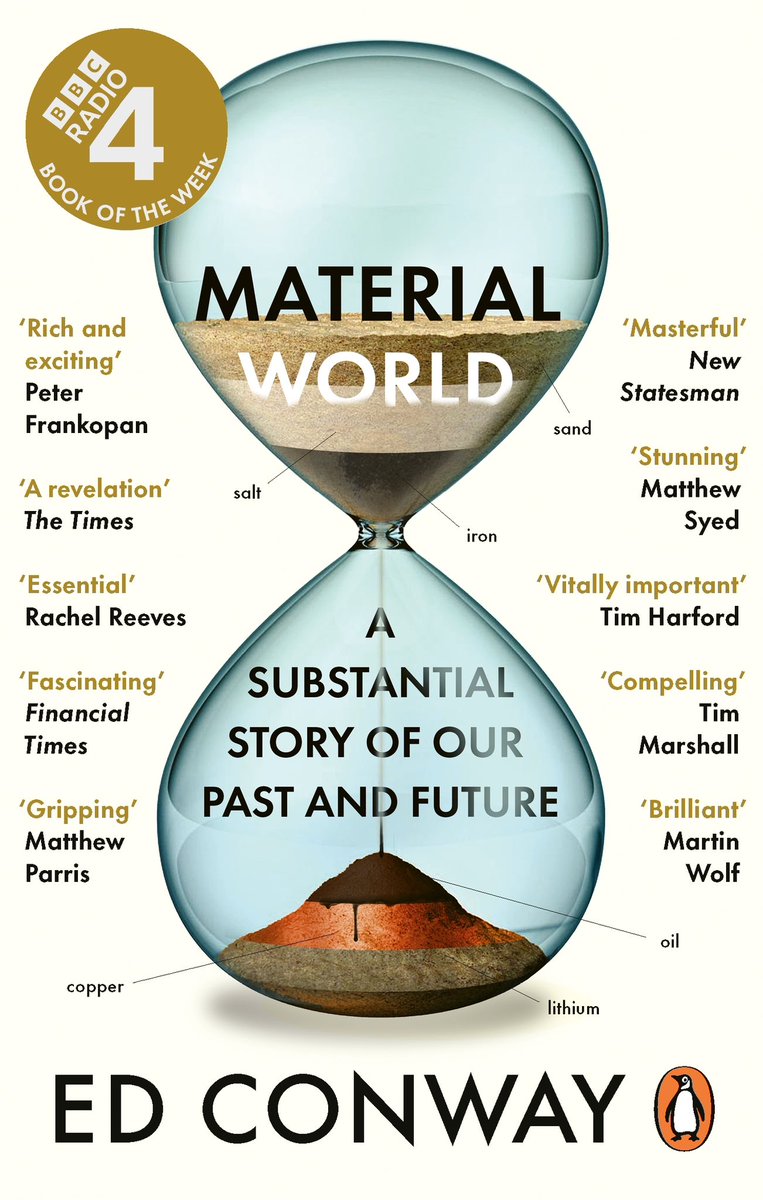
Advocacy is boring, sorry. Pointless, and boring. People who love it love the rationale it gives them to form a group and go into battle.
We could redirect that energy to the calm materiality of problems. The material world *is* the social world, in its most intense form. /8
Fixing material problems also unifies people, socially and culturally. That’s what the Romans knew, and why their empire lasted for so long.
The Victorian empire was exactly the same. Engineering at its core. /9
One of the reasons I never go to conferences is because I think it’s ridiculous to think that talking to one another solves anything.
A very large proportion of the most successful organisations in history were run by engineers. /10
Not because they implemented ‘technological fixes’ to more complex social problems. But because they looked at all the hot air belly-aching of a social problem, and said ‘hmm, you know if you actually just did this…’.
/end