From 2020, I think we've mistaken means with ends, with Covid. The end was always disease control. Disease…
From 2020, I think we've mistaken means with ends, with Covid. The end was always disease control. Disease control shouldn't be permanent masking, or in some situations even permanent ventilation. /1
https://t.co/EUdkkxFt34 https://t.co/w9930Lxdh6
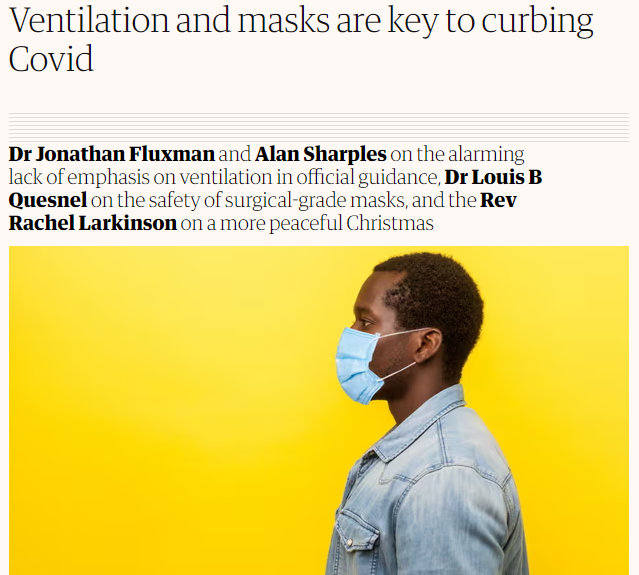
As the letter says, Covid needs to be *curbed*. But curbed so it can be controlled, so that spread is reduced to a minimal level, most days.
With occasional outbreaks. Like most other infectious diseases that are controlled. /2
But tools such as masking and ventilation have become ends now, instead of means. One of the reasons we're not making progress with them is that there's no endgame in the suggestion.
We don't mask and ventilate and allow Covid to continue spreading. /3
We mask and ventilate to control spread. To reduce it to minimal levels, after which normal life can return as much as possible.
Masking for example may then cease. Ventilation is always good to have. /4
But just masking and just ventilating is not disease control. They're rallying cries in the team sports. They're two components of a control strategy.
A strategy to reduce spread to minimal levels. /5
I suspect in public consciousness there's an idea that Covid is a sort of constant presence, but ventilation and masking can protect us from it.
It's only a constant presence because it's not controlled. It falls in a heap pretty easily, when controlled. /6
To me it's an easier sell to say that the aim is disease control, and masks and ventilation are just steps along that path.
That it has an endpoint, of 'normal' life. It feels sometimes like we've extracted these tools and have made a fetish out of them. /7
The benchmark isn't, 'is everybody wearing a mask?', or 'is every building ventilated?'
It's 'is the disease under control?' That question focuses atention on the highly specific, and quite limited, action that's needed.
And its endpoint. One everyone would like.
/end