To be social is to conform. To not conform is also social. You can’t avoid conformity, when you act socially,…
To be social is to conform. To not conform is also social. You can’t avoid conformity, when you act socially, it’s the currency of social life.
The more social we are, the more rigidly conformist societies will become. /1
https://t.co/dSgr8MOY82 https://t.co/L0C5XSi1dL
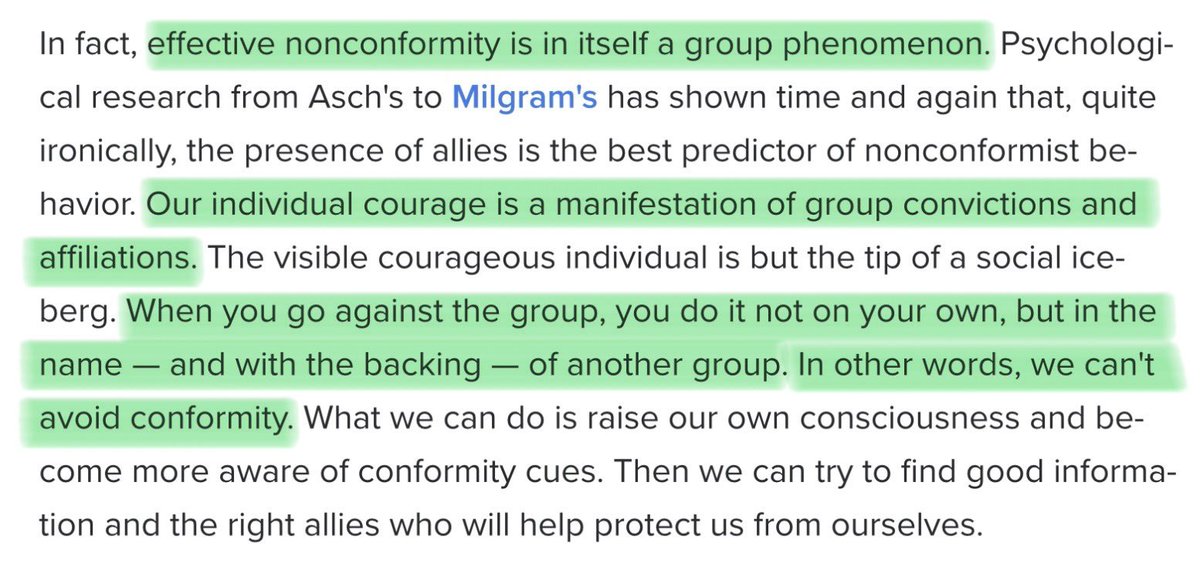
When the entirety of our social lives is transacted on platforms that weaponise and monetise this same process, conformity grows exponentially.
Because it’s not just conformity that is the root of social life. It’s competing conformities. Groups, or I prefer the word teams. /2
Teams captures the competitive process better than groups. Imitative rivalry, as Rene Girard called it.
So we end up with an exponential increase in both conformity, and a proliferation of teams. A cesspit of proliferating and competing conformities, plural. /3
Which, as Girard showed, always produces the same thing. Violence. Both physical violence, and violence to what today we call our mental health.
Nothing creates more anxiety in humans than this process of trying to conform. To belong. We call it ‘connection’. /4
Which sanitises the brutality of what’s actually going on. We want to connect because we want to belong. To belong, we conform. To conform is just peer pressure.
To be non-conformist, as above, is even more peer pressure, not an escape from it. /5
Often when I raise this topic, people will say something like ‘proudly non-conformist my whole life’. But that only makes a person even more wedded to and infected by this same process.
Non-conformists are obsessed with conformity. It’s their whole raison d’être. /6
As Noam Shpancer says in the original link, when acting socially you are *always* acting for a group. The same is true for both conformists and non-conformists.
Our whole lives use what we learn in high school. The continuous negotiation of group memberships. /7
What we call politics, or science, or any of our other adult activities, when stripped back, are exactly this same mechanism in play.
Constant negotiation of group memberships and boundaries. The more social we become, the more intensely the mechanism runs. /8
And therefore the more violent and anxious we become. The answer to most of the world’s problems right now is to be a lot LESS social.
To just let different jobs get done, without interference from sociality. To ‘mind our own business’, literally, again. /9
To let public health professionals fix pandemics, and climate scientists climate change.
To not have to negotiate thousands of teams of ignorant foaming at the mouth zealots getting in the way, by transforming somebody else’s business into fuel for their team sports. /10
It’s like that old joke. To get directions to where we need to go, ‘I wouldn’t start from here’. Social media IS the trap that we’re stuck inside.
It makes all of the problems we want to solve infinitely worse. Because social life is not a problem solver. /11
Use it as that, and your problems explode. I’m sure we’re all feeling that right now. Social life can rally people *around* solutions, to conform to them.
But those solutions won’t come from social life. Only rivalry comes from that, between teams, battling for status. /12
If we want our problems fixed, and fast (and they need fast action), we need to turn social media off. Desperate times need desperate measures.
We need to allow people to go back to minding their own business. To get stuff done.
/end