I’ve seen estimates that both in the US and Oz, people are getting Covid on average every 12 months. This…
I’ve seen estimates that both in the US and Oz, people are getting Covid on average every 12 months.
This factoid is trotted out to counter those who say people are getting infected multiple times per year. Is this the flaw of averages at work? /1 https://t.co/8tnxcFA8fo
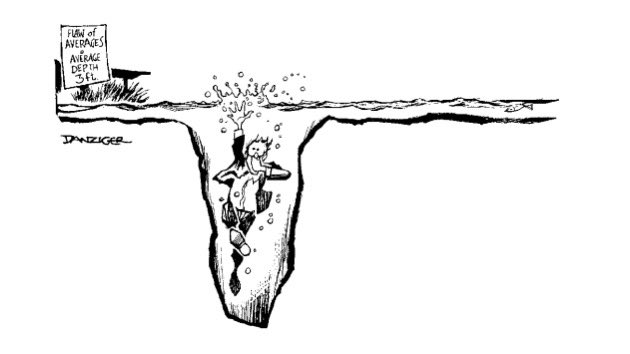
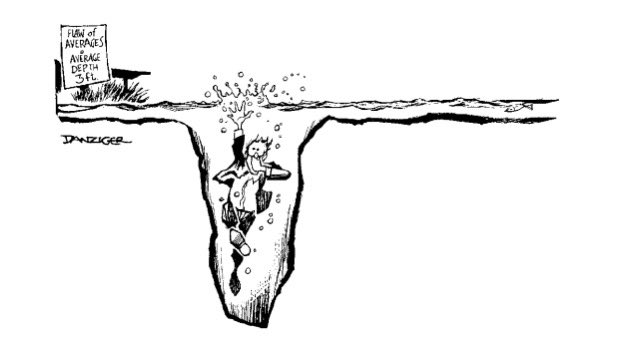
Epidemiologically I guess this is all about incidence and prevalence. Should we be using the average here, is it saying anything useful?
As the cartoon says, you don’t want to know the average depth of water if you can’t swim. /2 https://t.co/EoQC48oXhk
SARS2 has a low dispersion constant i.e. a small proportion of people do most of the infecting.
Given that, you would expect Covid will infect some people a lot more than others. Those in locations where superspreading is more likely. /3
Crowded indoor spaces like schools, for example. If you then calculate the average number of infections across the entire community, it may be quite low.
But have you discovered anything useful by doing that? /4
A low-dispersion superspreading pathogen will likely always produce a low *average* number of infections, across the community.
It means the pathogen is not being controlled. That’s how it behaves, when uncontrolled. /5
And given that on average a persons gets influenza every 10 years, we’re miles away from Covid being a public health problem even of that magnitude.
It’s much, much worse. /end