Coming back to this because it seems such a critical paper, one of the few to really address hybrid immunity…
Coming back to this because it seems such a critical paper, one of the few to really address hybrid immunity and model how it might be going (if it even exists). Some key extracts. /1
#auspol
https://t.co/JEyitkVrY1 https://t.co/83dkNZNoJx
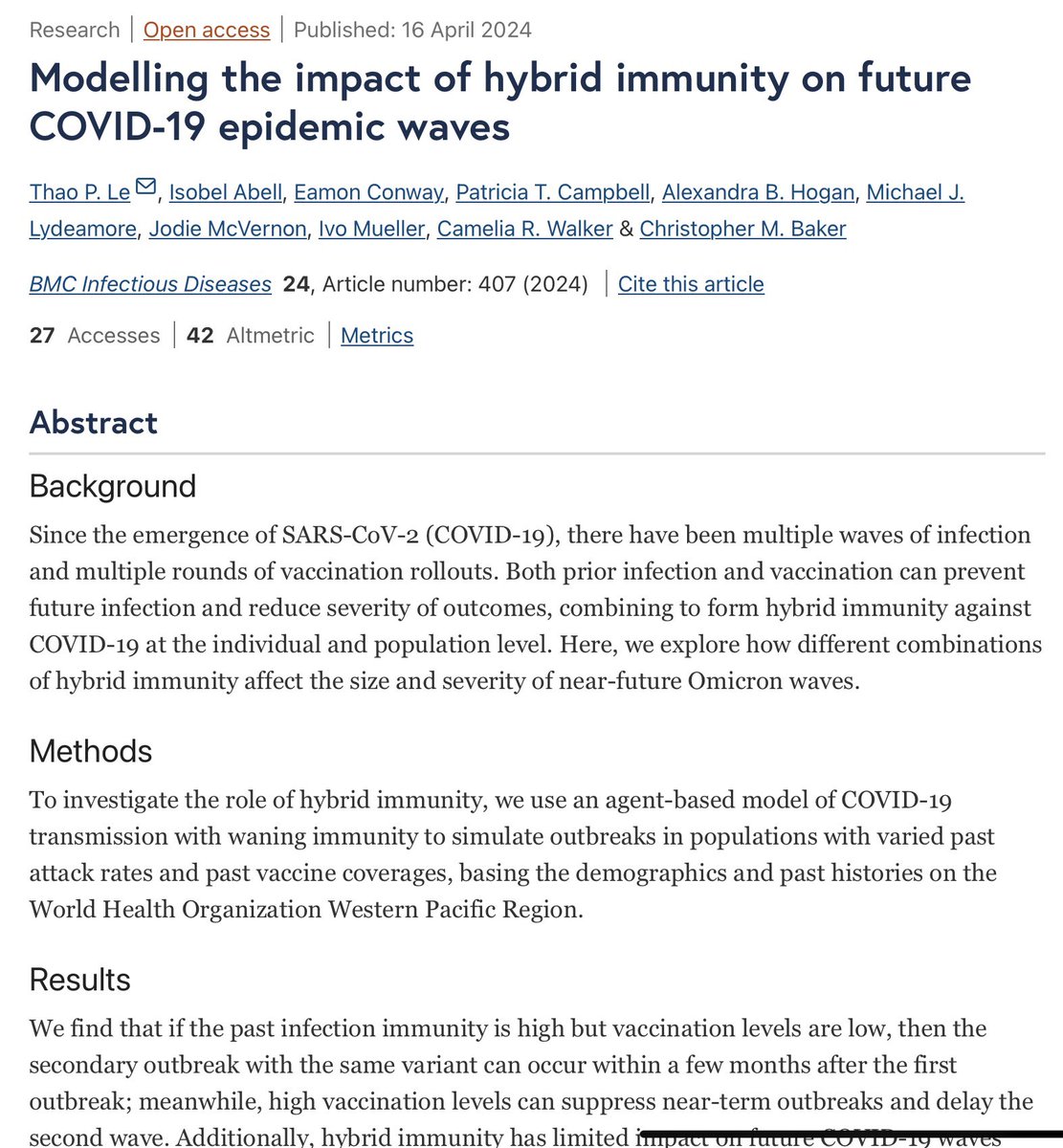
Fundamentally the paper talks about the importance of ‘epidemic history’ for a given population, the particular and unique exposure to infection and vaccination.
One of the challenges to even the idea of hybrid immunity is the hypermobility of many populations. /2
Even if (a big if) a given population was isolated from other populations, the idea of hybrid immunity requires a near-miraculous alignment of ‘epidemic history’ amongst members of that population, to create anything like population-level immunity. /3
Individual immunity within that population will be highly variable, dependent upon the personal history of infection with the virus, and vaccinations.
One of the fundamental requirements for population or herd immunity is coordination. /4
Having lots of people with about the same (high) levels of immunity, *at the same time*. That synchronic element is often missed.
Why only vaccination has ever created herd immunity, in practice, where you can coordinate the timing of immunity for masses of people at once. /5
Leading to a question I’ve asked before and never seen answered, whether those who advocate for hybrid immunity are talking about individuals, or populations.
Are they saying hybrid immunity will create herd immunity? /6
Or only that each individual will get enough immunity through infection and vaccination to protect them from ongoing severe disease?
Nobody seems to want to say. The former seems impossible (the synchronic element). The latter profoundly irresponsible. /7
The paper also (wisely) targets immune-escape variants, the ones we’ve been living with. Clearly immune-escape is a problem for any lasting immunity.
A powerful paragraph here about ‘natural infection’. /8
“For scenarios where the past attack rate is higher than 50%, we observed that different vaccination coverage levels have noticeable effects…If vaccination coverage is only 20% then a high past attack rate is insufficient to ensure a low future resurgence of of infections…/9
…with the same variant. This is most likely due to the high intrinsic disease spread which caused the high past attack rate and similarly caused the high near-future attack rate, as well as *the short-lived nature of immunity derived only from natural infection.” /10
(My emphasis there.) ‘Natural’ infection with low vaccination, which is pretty much most countries now, creates only short-lived immunity. Meaning forever-Covid, the endless pandemic. Not endemic, PANdemic. Wave after wave of mass disease. /11
Importantly the authors also note the benefit of vaccinating low-risk groups, such as children, as modelling shows vaccinating only high-risk groups made little difference to population severe disease outcomes. /12
Just as critically the modelling showed that for immune-escape variants, pst attack rate had a linear relationship with future attack rate. Or in other words high prevalence led to not just high prevalence in the future, it led to even *higher* prevalence in the future. /13
We can’t infect our way out. Infections breed and multiply infections. (None of this is surprising.) To quote: “We find that high vaccination coverage makes a noticeable difference in reducing the number of infections and severity outcomes in populations. Additionally,…/14
…a population with a high past attack rate - reflecting a society with certain mixing and environmental factors that increase disease spread - is likely to have a high future attack rate and will benefit from higher vaccination coverage.” And to continue…/15
“We also found that high vaccination coverage can *delay* the emergence of a second wave. This delay is important because a longer time between waves allows more time to vaccinate populations, fewer infections and deaths across the same time frame, less economic disruption,…/16
…and so forth.” And finally, “Our results suggest that populations with low vaccination coverage and high past infection rate should still consider vaccination if public health measures are not enforced or social mixing is not reduced…our work suggests that populations…/17
…with high past infection rates will likely continue to have high future infection rates, if nothing were to change”.
There it is, in black and white. Hybrid immunity skewed heavily to ‘natural’ infection is a sham. That’s most populations now. /18
Vaccination rates have flatlined. Hybrid immunity is just code for continuous infection. For doing nothing, in other words. A recipe, as the modelling shows, for not just eternal Covid but for *increasing* Covid.
The solution is to vaccinate. Lots. /19 https://t.co/pOvyjXXv4P
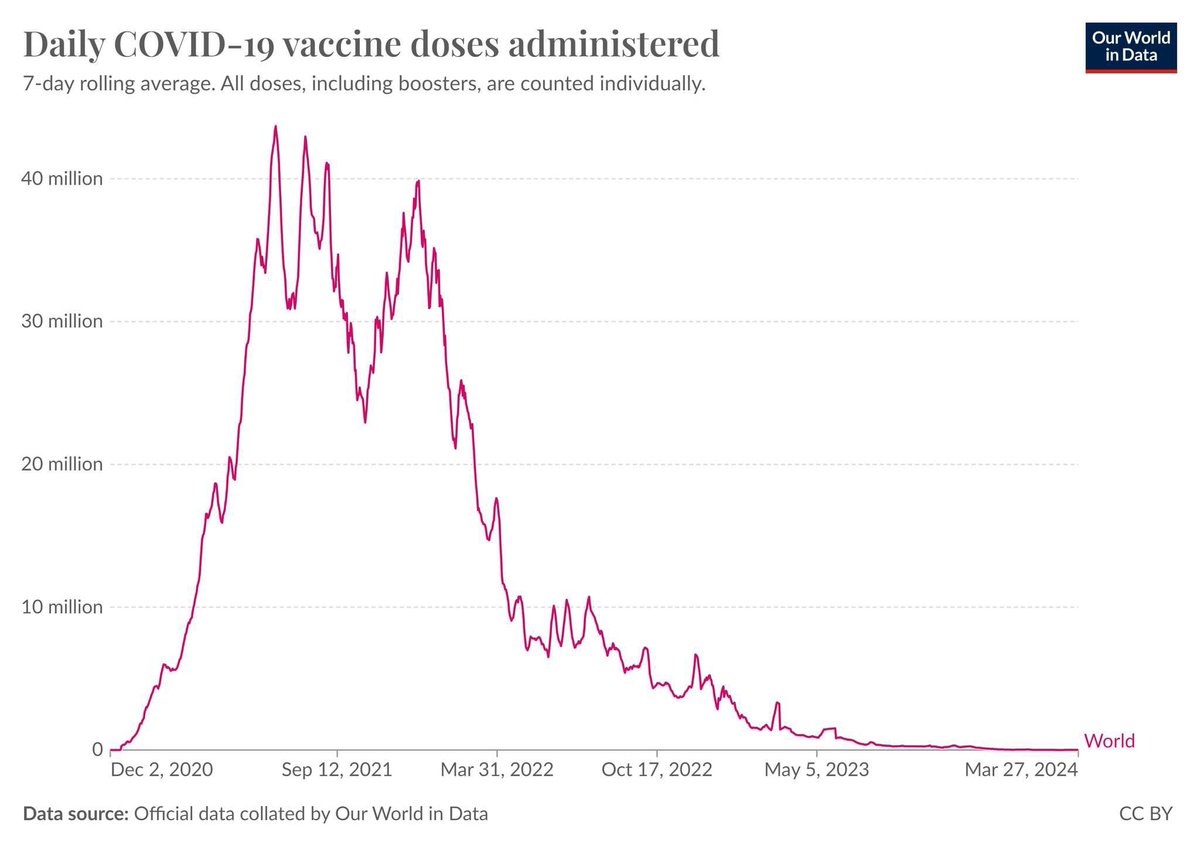
And to take public health measures, though cooker activists seem to have spooked politicians beyond that now being possible. The anti-vaxxers may also have achieved that with vaccines. But as the research shows, vaccines just need to reduce viral load to end a pandemic. /20
They don’t need to be ‘sterilising’. Ongoing and continuous mass vaccination may be our best hope, politically. Though with politicians uttering cowardly inanities about ‘vaccine fatigue’, hope is also heroic.
Either way, hybrid immunity is nonsense. /21
And without significant increase in vaccination, offensively stupid nonsense. /end