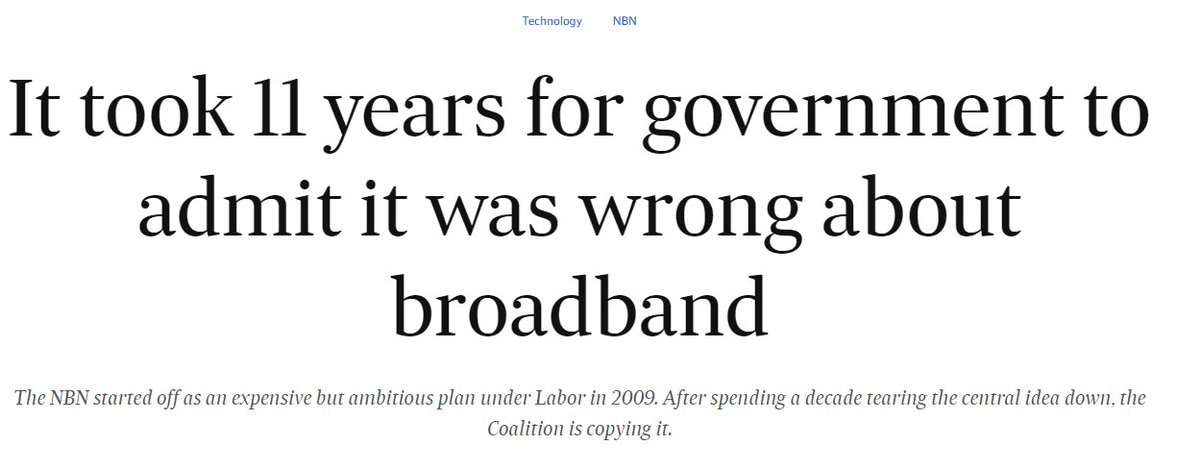
The LNP at the time said government shouldn't 'pick winners', leave it to the market. The same fallacy that…
The LNP at the time said government shouldn't 'pick winners', leave it to the market. The same fallacy that says democracy is what 'the people' decide should happen. Groups of people don't decide anything. In markets or democracies. All change is led. /1 https://t.co/s7R6XkNmQi
Groups simply don't have agency. Not because it's denied them, but because there is no such thing as a group mind. Groups (like 'the people') appear to have a collective mind when they do things like vote, or buy one product rather than another. /2
But that's always because individuals in that group follow others in the group, in turn following some higher-status person who has chosen a direction. A decision is always led by some tiny number in the group (about 5%). That's true for politics, organisations, etc. /3
The idea of 'the people' is functionally equivalent to the idea of 'the market' in economics, the idea that optimum outcomes derive from allowing individuals to choose for themselves. But 95% of individuals will just follow what everybody else is doing. /4
We have words for it, things 'trend', they 'go viral'. We all went to school, we KNOW this is how collective human behaviour happens. There is no wisdom in numbers. (There may be wisdom in crowds if run in a highly specific way, as James Surowiecki showed.) /5
But that way is not a market, and it's not voting. Both of those are petrol poured on the fire of social emulation, imitation. They actively produce and amplify fads, fashions, 'viral' behaviour. /end