One of the useful things about this platform is that it gives you a direct way to see the myth of the idea…
One of the useful things about this platform is that it gives you a direct way to see the myth of the idea that societies are made up of a collection of individual viewpoints. Like LEGO blocks stuck together. It’s absolutely not how societies or even groups work. /1
When you scroll through your feed, it can give the impression of being a sort of addition of views. The Tweets all share the same seamless space. But pause even for a moment over the individual Tweets and you’ll see something very different. /2
Each is like a window not into some tiny fraction of our overall collective view. Each is all of reality, viewed through one specific viewpoint. It may be focused on one specific topic, but through the lens of how that person sees the WHOLE world. /3
This is profoundly different to the idea that collective things are made up of lots of individual component things, added together. Our electoral process has created that misunderstanding, where ‘the will of the people’ really is just the adding together of individual things. /4
Just marks on a piece of paper, the ballot paper. What’s notable there though is this only becomes possible where the entire context of why a person crosses one box rather than another, is stripped away. Voters are just numbers, able to be added together. /5
Some say of elections that ‘the people have spoken’. But they don’t speak, that’s the point. They make simple marks that are able to be numerically added. It’s politicians and commentators who then *project* a ‘voice’ onto those marks, to say what they mean. /6
What ‘mandate’ they imply. One of the reasons I say to never, ever trust anybody who talks a lot about ‘the people’ as a justification for what they’re doing. The people is not a thing, it’s a mathematical construct, from voting, able to be then inserted into any narrative. /7
And I’m not saying ‘the people’ are betrayed by the voting process. I’m saying ‘the people’ doesn’t exist. Humans do not act as a collective body in that way. Go back to Twitter to see this. Every Tweet is each individual seeing ALL of society and reality, in one way. /8
Again they may be talking about something very specific, but they’ll be doing that through the lens of their way of understanding everything, in society and reality. Each believes something for a whole range of contextual reasons, based on their entire ‘worldview’. /9
When you scroll through Tweets in a feed, you’re not seeing the atomic components of some collective view of the people. You’re scrolling through worlds. In more technical terms, you’re not seeing society’s atoms, you’re seeing its monads. (Another thread, another day.) /10
How do you then transition from all of these individual worldviews (world-views, the term is literal) to some sort of collective thing? Well…you never do. Not because we’re all isolated individuals, the libertarian fantasy. But because we don’t ’add up’ in that way. /11
Populations act collectively when there’s some *overlap* of all of these individual world-views. Where each person decides to lend some support to some proposal, from within their own world-view. Two people may support the same thing for *entirely different reasons*. /12
Individuals never surrender their individuality to these collective things, they always just lend their support to them, a provisional support that can be withdrawn at any time. And what will determine that is their entire world-view, on all of life. /13
Politicians know this, it’s why they poll continuously and live in fear of every single poll. They know that peoples’ allegiances are constantly shifting, based on how individuals perceive proposals from within their entire world-view. It’s why they create ‘narratives’. /14
They know people are less focused on a specific topic than on the impact that topic has on their entire world-view. Narratives offer world-views. Our politics is not a battle of specific issues, it’s clashes of entire world-views. Researchers have shown this, empirically. /15
Look what happens when you map the actual views of voters in traditional categories, like moderates, independents, undecided etc. They’re all over the place, hardly anybody agrees on anything. This is true for rusted-on voters too. This is why politicians LOVE elections. /16 https://t.co/TQ4VHqSyCo
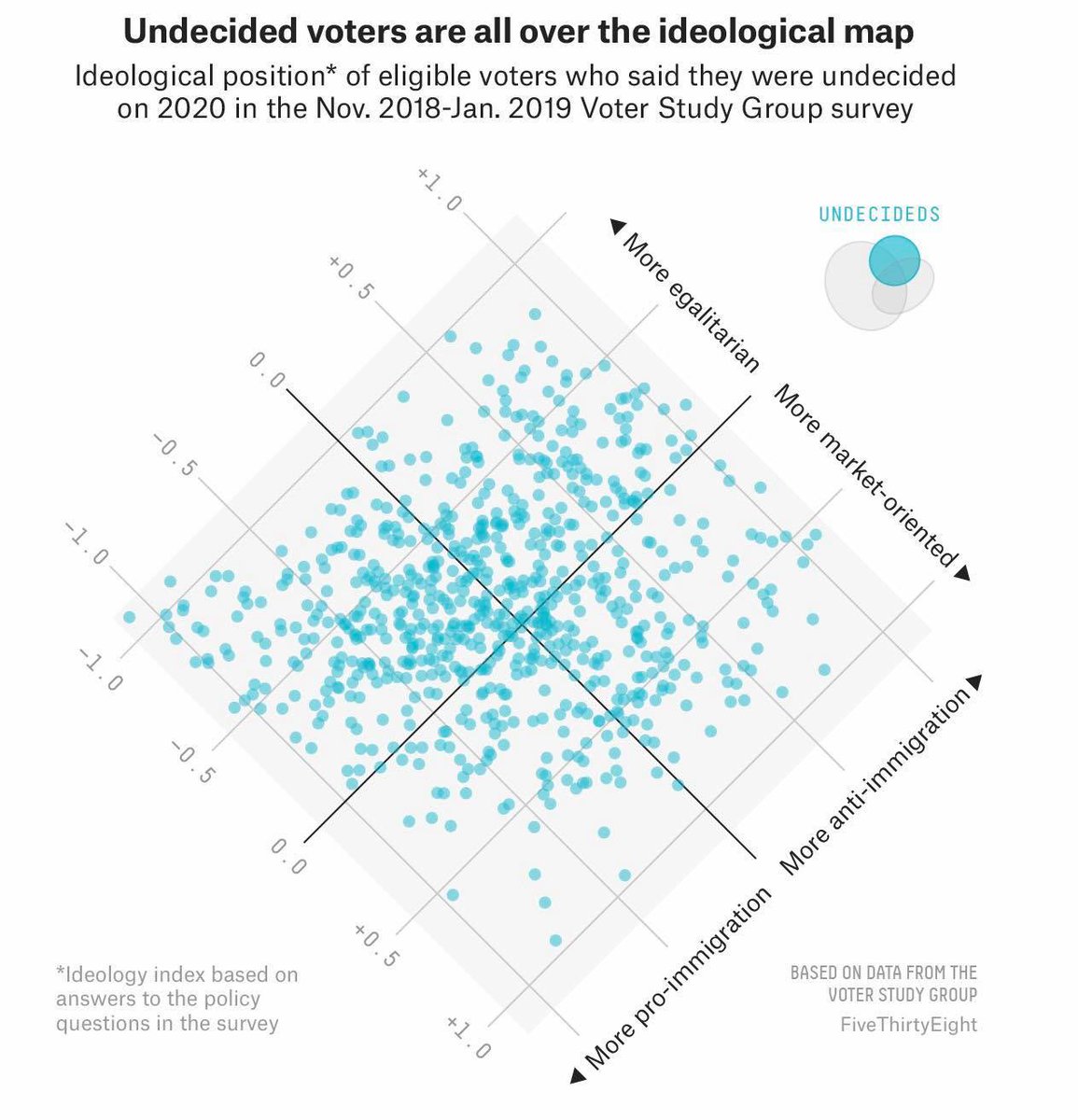
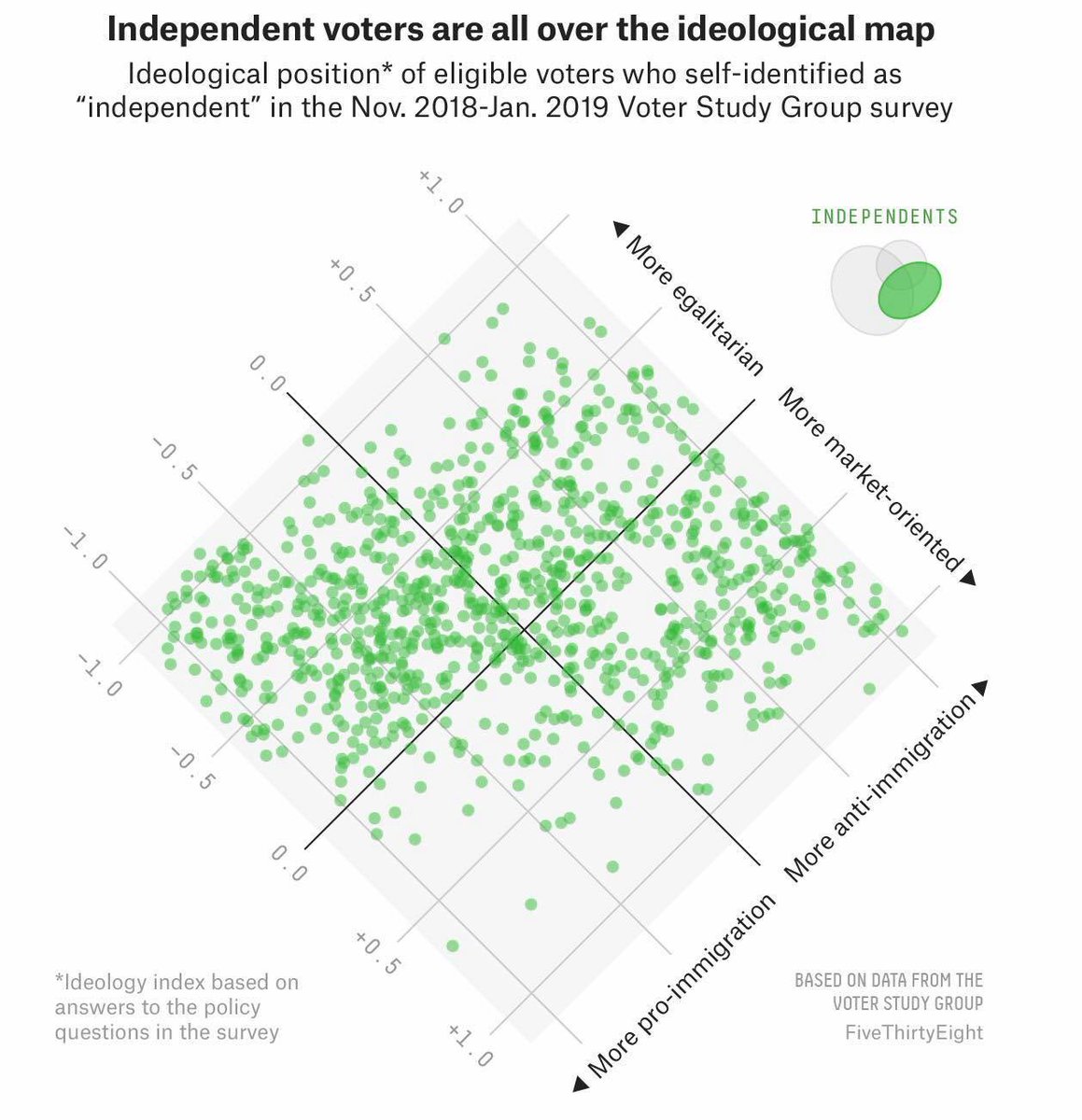
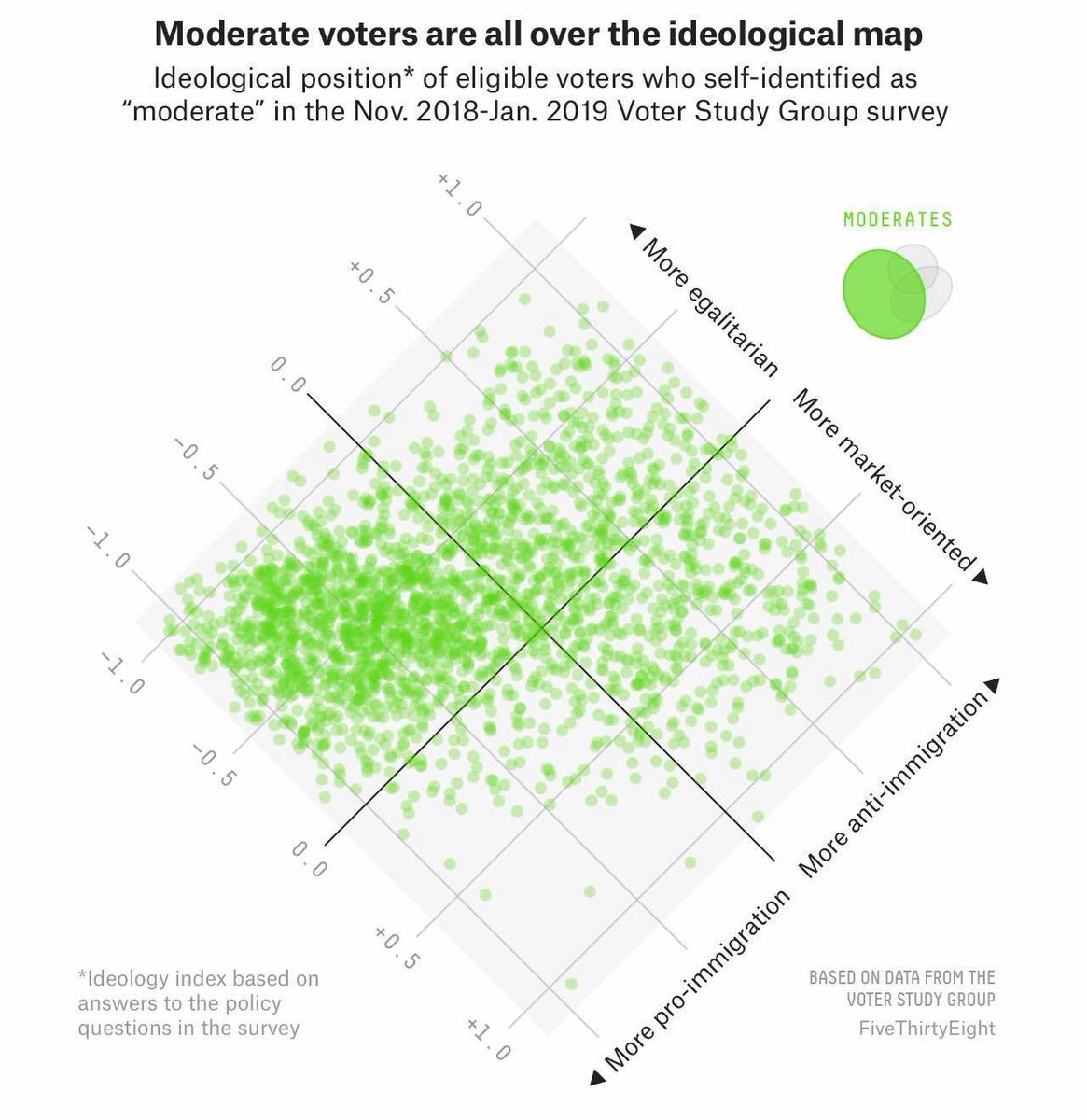
Elections allow them to bypass this enormous diversity in world-views, and speak on behalf of ‘the people’ on the basis of a simple number, that ignores the diversity. But they also discover how tiny and provisional support given by individuals is, when narratives shift. /17
Both the UK and Oz for example have had revolving-door prime ministers in recent years. The support individuals give to any politician is always provisional, and can shift quickly and brutally. All on the basis of entire, whole pictures of reality and society. /18
Not added together, individuals don’t ever surrender their sovereign world-view. They may choose to act in concert with others, but *each for their own individual reasons*. Why I also say the distinction between individual and collective is a false one. /19
All of our views are collective, they’re based on our individual world-views. But we’re also individuals, at the same time, always. Even when acting collectively. Our collective life is us individually lending some tiny part of our attention and energy, to a shared cause. /20
For our own reasons. There is no group mind, no ‘the people’. There are world-views/narratives, stories about how all of reality fits together, that can be shared, and which individuals can subscribe to, to a greater or lesser extent. /21
That’s what creates the illusion of ‘the people’. People will shape those narratives in their own ways, constantly shifting and modifying their world-views, creating constantly shifting allegiances. Good politicians know that ‘the people’ is really about shared narratives. /22
Why they will be much less interested in specific issues than they are in creating world-views. Like aspirational world-views, ‘if you have a good, you’ll get a go’. And why defeating bad things is about creating other world-views, not throwing data and facts around. /end