It was Lynn Margulis I think who said all life is really bacterial. That the huge variety of flora and fauna…
It was Lynn Margulis I think who said all life is really bacterial. That the huge variety of flora and fauna on Earth is all the product of microbial activity, mostly bacteria. This matters fundamentally in a pandemic. The example of cyanobacteria. /1 https://t.co/l9Zn8UWnJs
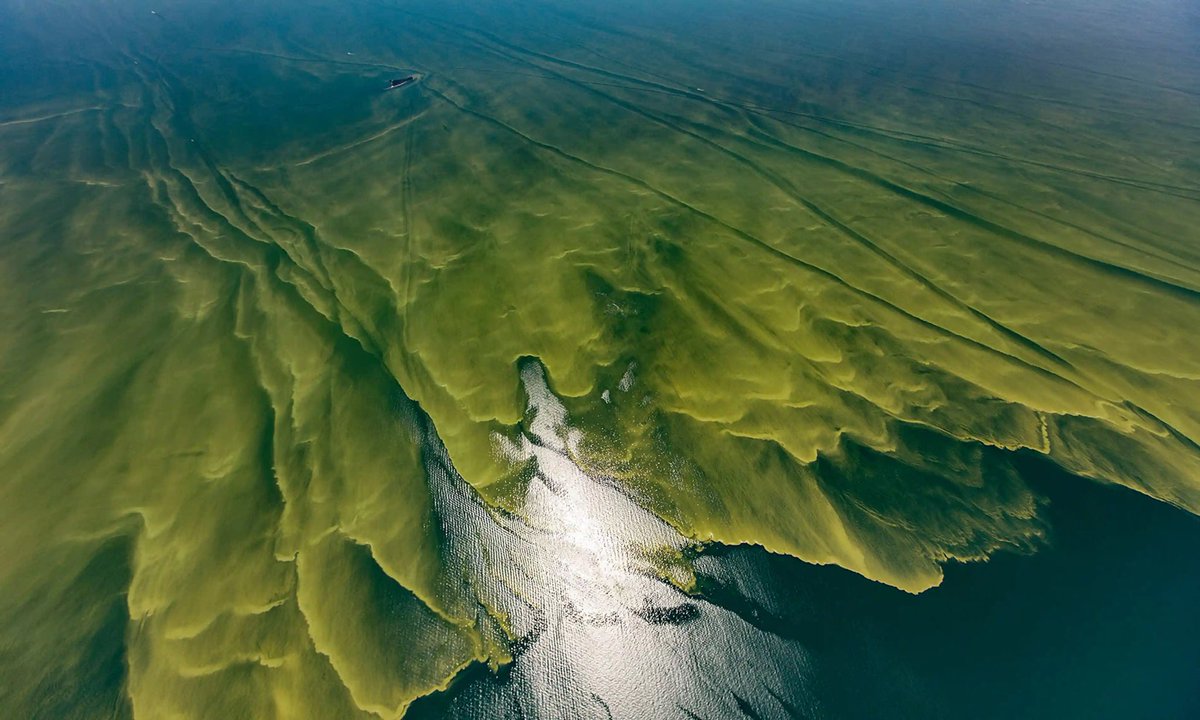
Cyanobacteria are probably the ultimate example of the highwire act Michel Serres talked about in his early book, The Parasite. Both enabling and destructive, at the same time. Responsible for creating much of our modern breathable atmosphere, oxygen factories. /2
But in doing that, they also killed about 90% of life that had evolved in the first couple of billions of years of Earth history, in the Great Oxygenation Event. Much of it had been anaerobic, and oxygen was a toxic poison to it. /3
‘Blue-green algae’, not strictly an algae but a bacteria, is probably the greatest mass murderer in all of Earth history. Some researchers even link it to the other mass extinction events. But as Serres would say, without it we wouldn’t be here today. We couldn’t breathe. /4
The fascinating insights Margulis’ work leads you to though make you realise that all other life on Earth has always been a bit player, to microbes. Some bacteria for example will pretty much live forever, provided they’re fed and watered. They don’t age. /5
‘Macrofauna’ - all the plants and animals and other living things on Earth - are constructed by microbes, inhabited by microbes while alive, and return to microbes on death. We’re the finite mortal experiments microbes make in construction, to further microbial ends. /6
Their focus is literally eternity, they will quite happily cast any organism aside as just one more fun experiment, to make another one. That’s really what evolution is all about. Not some progression to some higher perfection, macro-life is *less* complex than microbial life. /7
So in this context, the idea of ‘living with’ pathogenic microbes is really quite sociopathically hilarious. Far and away the most common way microbes live with macro-life is to kill it. Not because microbes are evil, but because macro-life is just a series of experiments. /8
Aggregate structures microbes use, to further the ends of microbes. As in the Great Oxygenation Event, if other life gets in the way of furthering the end of some microbes, they’ll very happily sit by and watch them all die. To them all macro-life is intrinsically transient. /9
It’s like smashing something you’ be made out of Lego. Not a catastrophe, it can always be rebuilt or something else can be built with the liberated blocks. Our most fundamental vanity as humans is the idea we’re a more evolved form of life, to microbes. All life is microbes. /10
And us surviving doesn’t mean embracing microbes where we come across them. Many we come across will happily kill us. We’re no big deal to them. It’s understanding the fundamentally microbial foundation of all life that paradoxically makes microbial control so important. /end