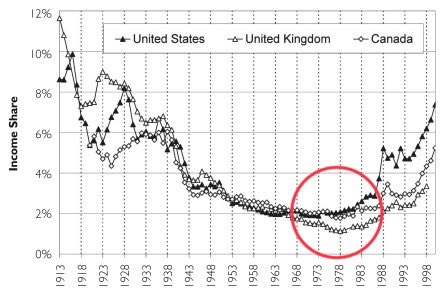
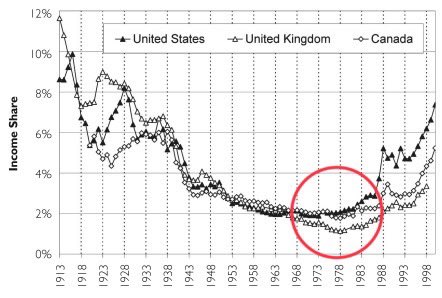
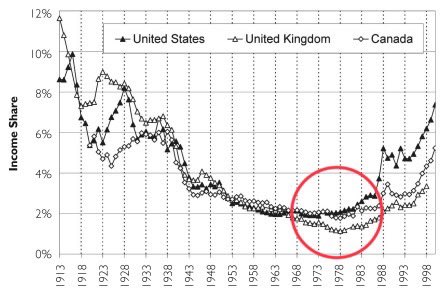
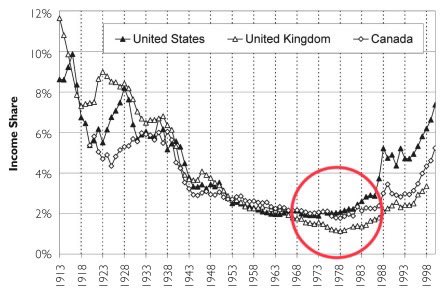
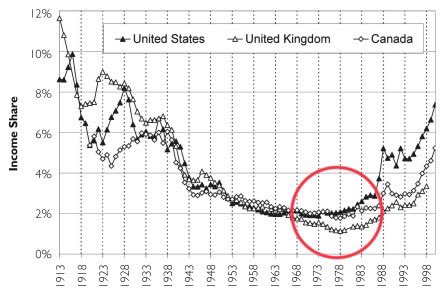
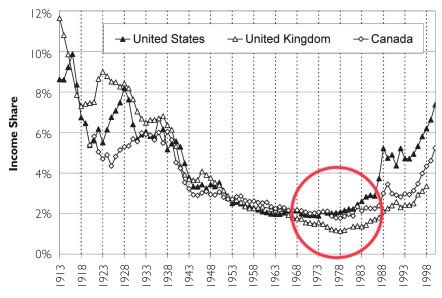
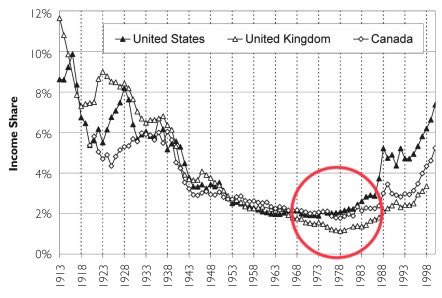
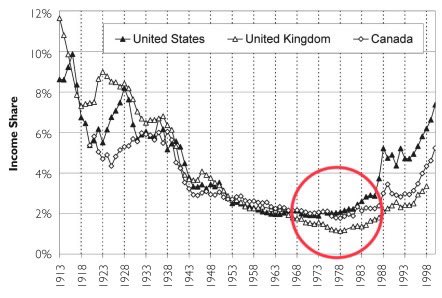
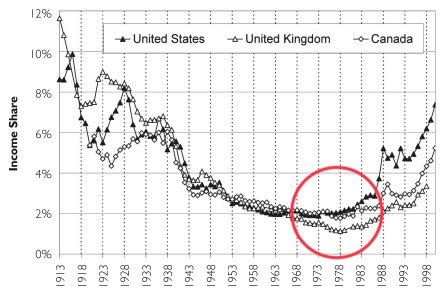
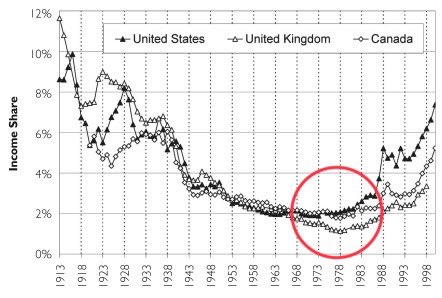
The income share of the top 0.1% of key (and representative) English-speaking societies. This history is…
The income share of the top 0.1% of key (and representative) English-speaking societies. This history is usually written economically. But it’s much more interesting than that. A thread about the real origins of ‘the economy’. /1 https://t.co/fOpPogmmIB
As I Tweet about a lot, all life that we live is social, most fundamentally. Humans live together in groups, and those groups are driven by some pretty standard social behaviours, through all of history. Specifically, groups are structured by hierarchies of status. /2 https://t.co/Uh1Uu5cKEs
About 5% of any group of any size, from a tennis club through to a full nation, lead the rest of the group. The other 95% of the group follow, by imitating/emulating the 5%. Not because humans are stupid, but because nobody can do everything, we all have to take our cues. /3 https://t.co/exv3rRFumF
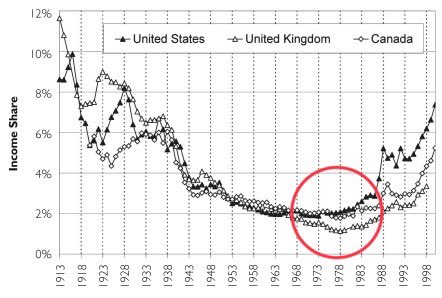
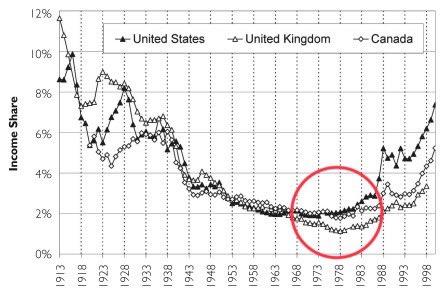
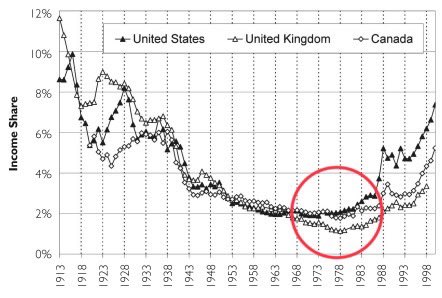
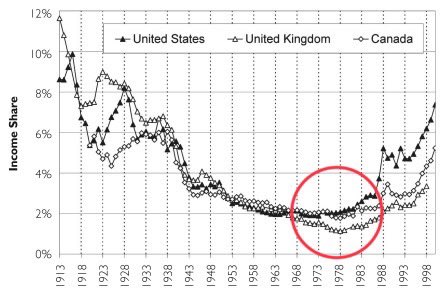
To return to the graph. You can see that at the beginning of the 20th century, the wealth concentrated in that 5% of society was enormous. While the graph ends before the 21st century, that trend has continued to today. The 20th century was an anomalous dip. /4 https://t.co/U7MLBAiChC
Everybody from communists to socialists and capitalists have interpreted all of this entirely economically. Ongoing, never-ending arguments about wealth distribution. But few stop to ask, why does this happen, socially? Throughout all of history. Status is why. /5 https://t.co/sPHvvUCKWS
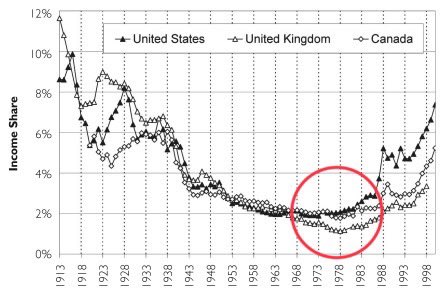
It’s what all people aspire to, status for themselves and the groups they’re part of. To be recognised, to have ‘power’ and resources. Respected. The relative levelling of inequality in the 20th century must then have a social cause too. And it does. Mostly, catastrophic wars. /6 https://t.co/9U373Hujzv
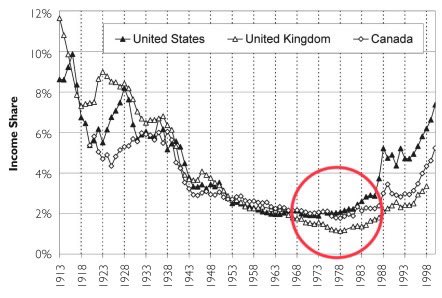
Those wars stripped away existing social hierarchies, to mobilise societies to fight these global conflicts. Families with entrenched privilege and land found themselves surrendering status and wealth, to help with the war effort. We didn’t suddenly become more enlightened. /7 https://t.co/m9ZI2dPYae
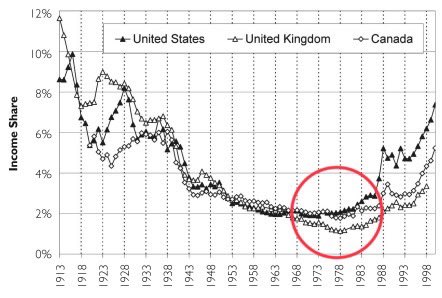
Their status was removed from them, due to wartime pressures. Like I say a lot, only catastrophe really creates meaningful and dramatic change in societies. The social status/imitation mechanisms are far too powerful to be upset by any sort of reasoning or belief system. /8 https://t.co/2Qorybvs5q
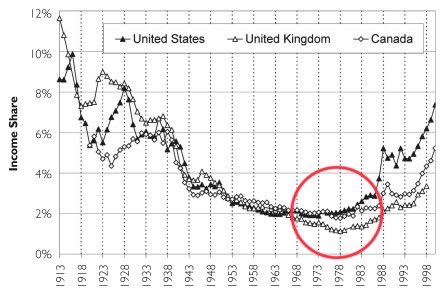
And now, to the red circle. That critical period from the late 1970s I also Tweet about a lot. Economically you can see it represented the beginning of the end of the levelling of wealth, its reversal. But what happened *socially*, to do that? That’s the important question. /9 https://t.co/9taAq0aqKk
Status needed to find a way to disrupt the levelling of the post-war public institutions. (Note that this isn’t just ‘elites’ scheming. All humans will default to social status games.) Status needed a mechanism to turn around those post-war shifts. Enter - ‘the economy’. /10 https://t.co/NGMtmXapXf
I always scare-quote ‘the economy’, because it’s become such an accepted part of our lives that people assume it always existed. Like air, or water, or stone. They point to trade going back millennia. This is the mistake. Yes there have always been ‘economic’ transactions. /11 https://t.co/IQkQ468KHY
But ‘THE economy’ (the THE is the critical thing) is not that. It’s a much, much bigger claim. That all of these transactions are just cogs in a much bigger machine, that acts independently of society. That enables it, provides all of its resources. This is a balls-out con. /12 https://t.co/EWySXBoj1G
Because when you unpack what ‘the economy’ entails, you can see clearly the 100% social manipulation going on. An economy is made up of ‘markets’, free-floating independent individuals thinking and acting alone. On face value, the complete removal of all status-driven life. /13 https://t.co/OCozdbaLEu
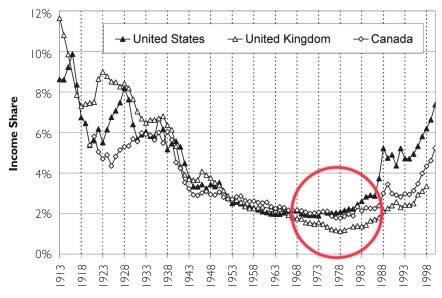
But that’s the trick. Because as the graph shows, once you let the economy rip, astronomical inequality returns to societies. That appearance of a status-free method of regulating human affairs is just a disguise to allow status back in. It provided the cover. /14 https://t.co/qy8zRf8BS4
All the ‘free market’ politics that took off from the late-1970s was really this social change. A way for people to use social status again, while pretending they weren’t. By pretending that the inequalities that returned were the ‘equilibrium’ outcome of free-market trading. /15 https://t.co/AJ7YVvIV3g
It’s all in the specific details of modern economic theory, the magical self-equilibration of social life by the interplay of ‘supply and demand’, using money (monetarism) as the platform of that equilibration. None of the proponents of this nonsense live in this way. /16 https://t.co/bpdvKk7UcZ
They’re nearly always some of the greatest beneficiaries of this shift, enormously wealthy and powerful, claiming that’s because they’re much cleverer and harder working than everybody else. ‘The economy’ always was just a SOCIAL Trojan Horse to return status to the centre. /17 https://t.co/8rcIHVN5EV
Every time some sort of post-war type regulation is proposed to level inequalities, you can count on ‘the economy’ to pile on, with its enormous dictionary of slogans about ‘picking winners’, and ‘aspiration’ - ‘having a go, to get a go’, etc. Cutting the ‘red tape’. /18 https://t.co/wEYfShmRRb
We have fundamentally misunderstood this by using the same economic lens to try to understand it. It’s a social change, the economic mumbo jumbo just enables it. And to be clear, this isn’t to say the 20th century more level world was necessarily better. /19 https://t.co/mf1bnaHdAd
Up to a point it is, because everything functions better if everybody has enough to get by on. But humans crave status more than anything else. When the catastrophe of WW1 and WW2 faded, status was back. Under cover of this fiction, ‘the economy’. /20 https://t.co/ZXERHwjvV6
Modern conservatives know this, they’re much smarter socially than progressives. They know that the 99+% of society without their wealth will still vote for them, if they can turn that disparity into aspirational imitation. Imitative rivalry. Keeping up with the Joneses. /21 https://t.co/OGjV6NhibA
And that’s the politics they’ve been running for 70+ years, with huge success. Progressives are clueless, thinking everybody wants to return to the levelised 20th century. Which conservatives easily dismiss as ‘the politics of envy’. They know nobody likes being low status. /22 https://t.co/bcEbeO7W5c
The economy always was a social tool. It doesn’t represent anything in actual reality. It was a way to launder status, to reintroduce it to society while claiming to be doing the exact opposite. /end