Paul Ewald talks about the need to live with pathogens by engineering their evolution towards mildness.…
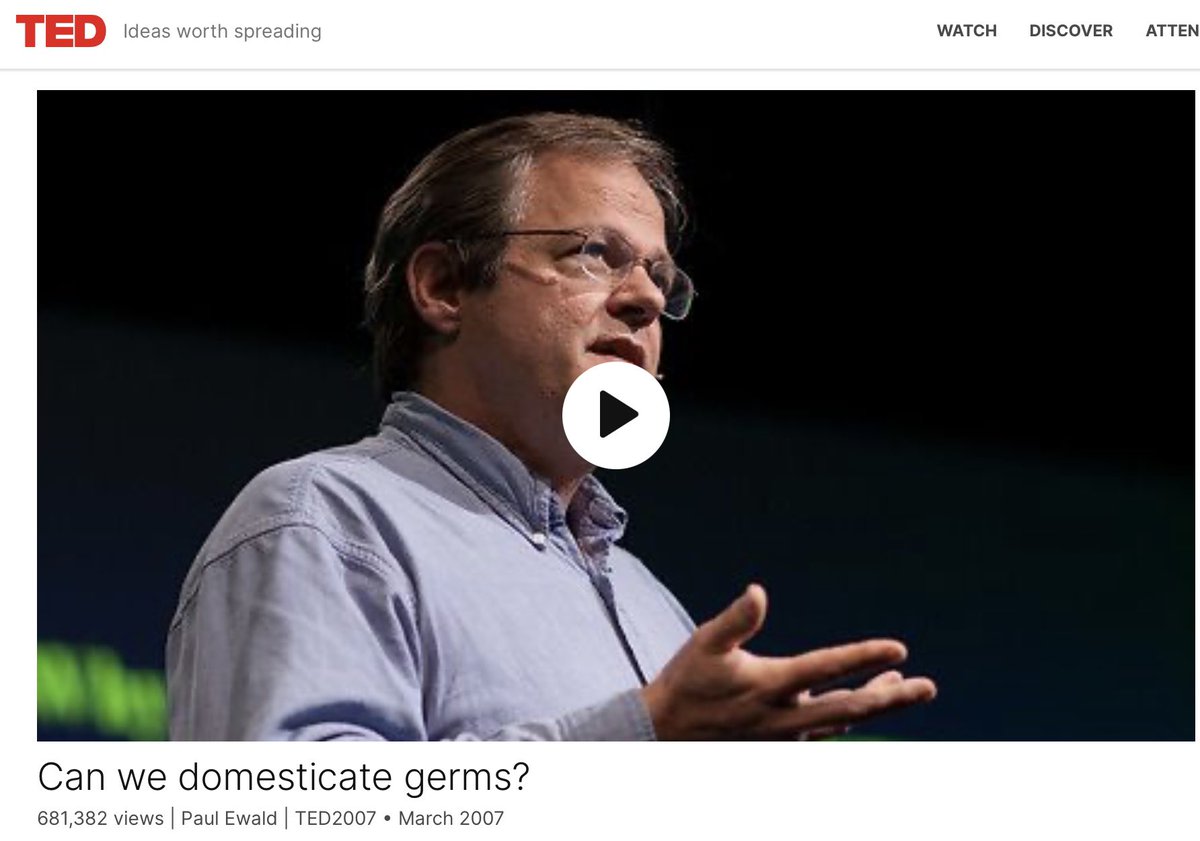
Paul Ewald talks about the need to live with pathogens by engineering their evolution towards mildness. (Something that won’t happen by itself.) Rather than doing nothing or trying to eliminate the pathogen, you *domesticate* it. /1 https://t.co/ZZeFERT0g8
In that way, the thinking goes, milder variants out-compete virulent ones. There’s a realism about this version of ‘living with’ pathogens that recognises the fundamentally microbial nature of life i.e. we can’t not encounter microbes. (There’s a but coming here though.) /2
An example Ewald sometimes uses is the virulence of cholera, depending on the quality of water available to people. Cleaning the water means cholera has to work harder to infect people, because spread is cut back. /3
This can lead to an evolution to mildness in cholera variants, as without healthier hosts, transmission is cut right back without the easy route of dirty water to spread it. Ewald has data to show that this seems to be what has occurred, in Peru for example. /4
You can apply this thinking to Covid. Cleaning the air should force SARS-Cov-2 to become more mild, because it loses the access to lots of fresh, easily available hosts. In evolutionary terms it’s then not in its interest to have high virulence, it needs every host it can get. /5
This is the main role then of NPIs (non-pharmaceutical interventions, like cleaning water and air, basic public health approaches). To work on the *environment* for pathogens, to drive them to mildness. Pathogens have an ecology, we focus too much on immunity alone. /6
It’s a sensible argument that informed the history of public health, that clean air, water and food in particular will have dramatic impacts on our health. Virulent pathogens so often emerge when these basics of life aren’t being looked after. /7
Including for non-human organisms. SARS-Cov-2 and other zoonoses for example often emerge when the environment for other living creatures is damaged. It’s a common sense argument for respecting the living conditions of all things. There is one but here though, perhaps. /8
I Tweeted yesterday about Epstein Barr Virus, EBV. It’s an example of a pathogen that for us is almost universally mild already, when we encounter it. But it gets much more dangerous over time, as it takes residence in us. Its chronic impacts are much worse. /9
I’m not sure how this gels with Ewald’s ideas. How would we engineer mildness for chronic impact, when we don’t know what the chronic impact will be? If the acute presentation is already mild, only time will usually say if the chronic impact isn’t. /10
Maybe this returns us to basic public health. Basic hygiene of air, food and water and respect for ecosystems might minimise these questions even needing to be asked. There are no utopias. /11
Ewald is also a strong advocate for the idea that many of our chronic diseases have an origin in chronic infection, so it’s definitely on his radar. /end