Creating infection-free public spaces as a ‘commons’ is an approach for Covid that is neither individual or…
Creating infection-free public spaces as a ‘commons’ is an approach for Covid that is neither individual or government-driven. A commons (you might have heard the name in relation to shared land, in the UK for example) is very similar to a community. About Elinor Ostrom. /1 https://t.co/PerzWGsXfR

Ostrom was the first woman to win a Nobel Prize in economics. Mostly for a career studying how commons work. An example of a commons, and one she studied at length, is water. One of the most contentious things to manage, worldwide. Our Murray-Darling disaster a clear example. /2 https://t.co/TfvGUe5i3Q

Ostrom, like many women (if I can stereotype), wasn’t convinced by the black and white binaries that dominated water management when she began studying it. When she looked at what was *actually happening* out on the ground, she found enormous complexity and sophistication. /3 https://t.co/XqTuB4Tryh

Yes there was government regulation. Yes there was individual action by impacted stakeholders. But often not some binary between those two things, which our politics always assumes will be the case. Over decades of studying lots of commons, she distilled the key components. /4 https://t.co/OXLEFoSdos

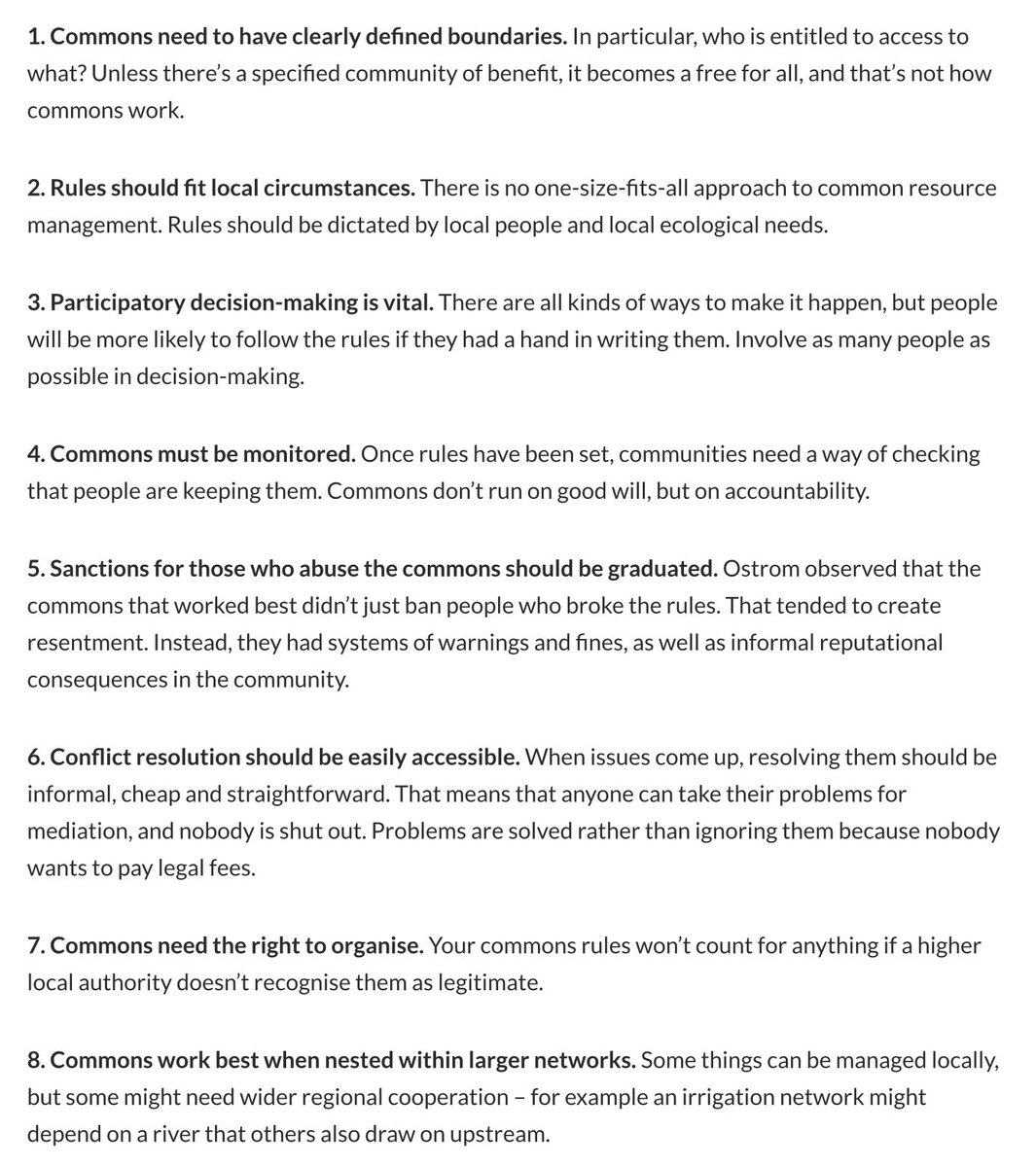
Into 8 key principles. Here they are. Notice they look nothing like ‘the State needs to manage this’, or ‘a marketplace of individuals will find the optimum solution’. The two tired bookends of our political debates. Read them, and imagine how they could be applied for Covid. /5 https://t.co/lxz0oystm5
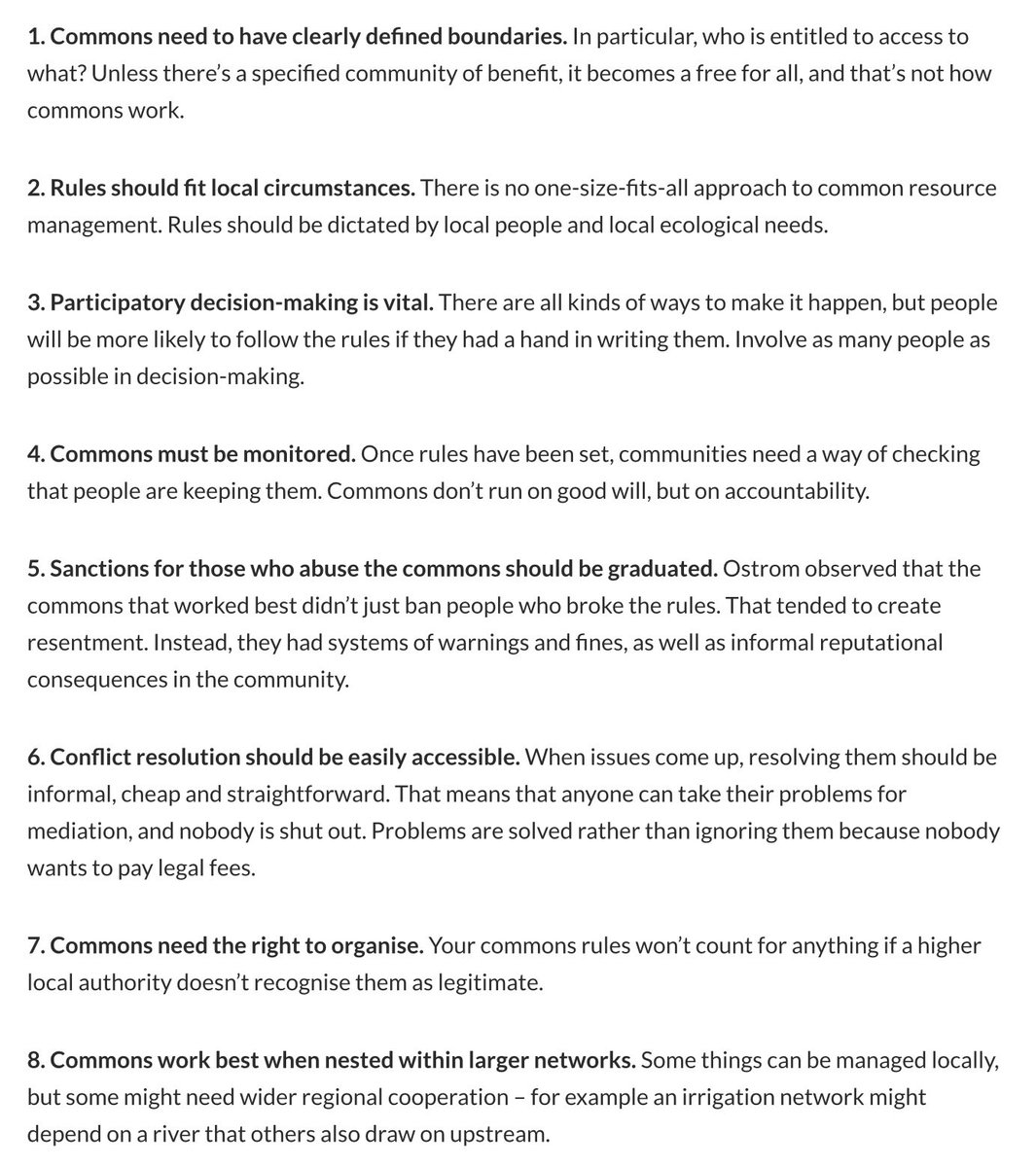
It’s not actually that difficult. And in fact good public health work in history has followed many of these methods. Notice regulation is in there, but not in some cartoon ‘oppression’ way. As is plenty of ‘free’ individual action. A mixture, based on outcomes, not ideology. /6 https://t.co/SHwvy9a71h
To come back to another thing I Tweet about, how Australia is very badly understood using any of the traditional European or US political categories. We’re not capitalist, or socialist, nor Left or Right. Australia has traditionally been governed predominantly by community. /7
For a range of historical reasons, not least having to find ways to survive in a prison colony at the other end of the Earth, and not having the luxury of space to debate ideologies. It was invent, or die. And this community-based politics is very much like Ostrom’s commons. /8
Read the 8 principles again. That beautiful mixture, ruthlessly pragmatic and compromising. That’s Australian modern history, not coincidentally also very like the Indigenous history it ignores and tried to wipe out. Osmosis was in play, I’m certain. /9
We learned about commons partly from the Indigenous Australians we were trying to displace. It’s how we survived. Indigenous Australians managed an even more sophisticated commons than those Ostrom studied. Their ‘stakeholders’ included the fauna, flora and geography as well. /10
In a civilisation spanning tens of thousands of years. Because of that incredibly sophisticated management, of a commons. That should be Australia’s contribution to the world right now, we have the operating system here for social stability stretching over millennia. /11
Unfortunately we also have remnant politics from the wealthy landowners and industrialists whose main interest was wiping all of that out and replacing it with the English motherland. It’s testament to the power of the politics of the commons that they haven’t won yet. /12
Look at our first 2 years of Covid here. Classic public health, but so successful because it tapped into that commons-based, community governance that defined this country. The COMMUNITY acted, together. Then at end-2021, the old patrician elites said enough. /13
Their ‘economy’, really spin for ‘the status quo’, was allowed to smash the commons-based work. And that’s the battle we’re in, right now. But the answer isn’t those boring, tired State vs individual debates, imported from Europe and the US. It’s to go back to the commons. /end
@RealOzSAGE a possible framework for thought and action The 8 principles are powerful, and empirically tested.