I wrote this thread to illustrate how societies are structured by social dynamics, not by politics, or…
I wrote this thread to illustrate how societies are structured by social dynamics, not by politics, or capitalism (or any of the -isms). All of those are products of the same social dynamics. A society is not a collection of ‘the people’. /1 https://t.co/xs9uVL1sY8
It’s a highly stratified collection of nested hierarchies, each following the rough rule of 5% leading, 95% following. Populist, libertarian/neoliberal (N=1) politics has led us to ignore nearly all of this complex nested set of hierarchies, replaced with a simple binary. /2
Between elected leaders, and everybody else. Still that rough 5%/95% split, but only one, replacing the many thousands in a modern democratic society. Those leaders are supposed to sit within that nested set of hierarchies, taking advice from thousands of officials, who…/3
…in turn source expertise from thousands more throughout society. Doesn’t matter if you’re a musician, farmer, plumber butcher, teacher, sportsperson etc., you will have your own set of 5/95 hierarchies reflecting the expertise in your area of work. About 5% of the people…/4
…in your work will be the elite, the top experts. They will then guide everybody else, who emulate them. That’s how all groups of all sizes work, it’s fractal, scalable. If you’re on a committee, roughly 5% of the members will drive the activity of the committee. /5
If you’re in a sporting club, about 5% of the members will drive what the club does. About 5% of staff of any larger organisation will be ‘management’. You can’t miss this pattern once you start to look. Conservative politics represents about 5% of the population, as its base. /6
The wealthy, the powerful, that’s its core constituency. It’s therefore very smart in understanding that this is how societies work, and it targets that 5% ruthlessly and relentlessly. While hapless progressives try to ‘mobilise’ the entire population against them,…/7
…N=1 politics ignores that fantasy and focuses exclusively on the 5%. It offers the 95% aspiration, because the social dynamics of 5/95 is that the 95 want to be the 5. Progressives offer the 95 pity, which they reject as (rightly) patronising. /8
Conservatives do politics as social dynamics, and that’s why the tiny handful of people they are wins so often. That’s the whole history of politics, of a tiny group of elite business owners (5), in modern parlance, lording over a vastly greater number of working people (95). /9
Only natural disasters and wars ever change this pattern, because until now progressives have been too wedded to the fantasy of a non-hierarchical society. So they pitch their strategies at something that doesn’t even exist. And thus they lose. /10
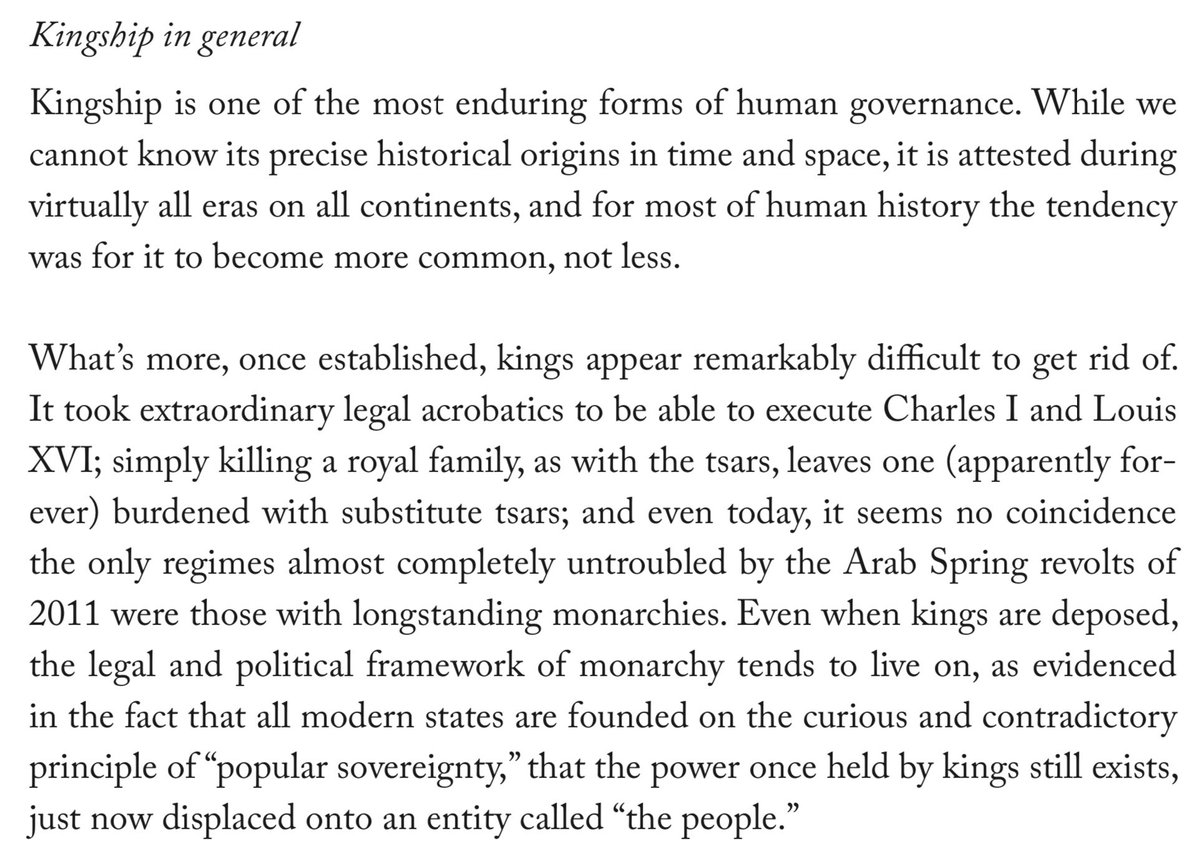
Just before their deaths, Dave Graeber and Marshall Sahlins published a book on this same topic, focusing on the role of Kings in history. I wanted to finish with just one quote from them, because Kings are history’s dominant 5%. Get rid of them and humans just reinvent them. /11 https://t.co/2PQ6f0aGRX

Notice their critique of the idea of ‘popular sovereignty’, which is the progressive view of how ‘democracy’ works. Where the King is replaced with ‘the people’. As they say, it’s a contradictory impossibility. Everybody leading everybody means nobody leading anybody. 12/12 https://t.co/3qn9i5HpKY