The corner shop represented a more resilient culture, logistically. The hyper-mobility that new forms of…
The corner shop represented a more resilient culture, logistically. The hyper-mobility that new forms of transport injected into our societies also stripped them of much of their resilience. Much of ‘freedom day’ type rhetoric is about the return of travel. #auspol #covid19aus /1 https://t.co/ycNE8vZ78b
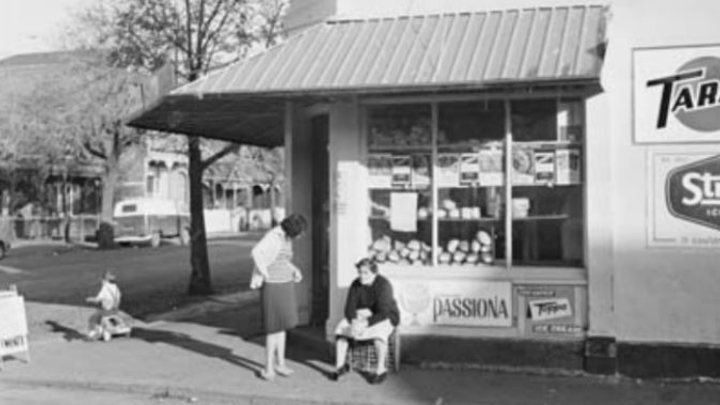
Communities had a greater level of fractal coherence, before mass transport. You had to reproduce community and services at multiple scales, throughout society. Now we just hop in the car and travel to and from massive retail multiplexes instead. /2
All of this mobility strips individual communities of their resilience. Those communities become not much more than car parks for workers. Very few suburban developments have anything more than houses. Vast sums are allocated to try to connect these suburban car parks…/3
…to work and services and entertainment etc., concentrated in metropolitan hubs. At the same time this mass mobility creates mass gatherings, in these hubs. Our buildings and transport are crammed full of people, mixing every day. Covid, anyone? /4
Have Tweeted before about the passion politicians who substitute the ‘Economy’ for society have for transport projects. The Economy is, at root, the dislocation of communities. ‘Supply chains’ of goods, services and labour replace community. /5 https://t.co/8Jk01n3Jdc
People get very worked up about ‘capitalism’. But we don’t notice as much that what allows us to ‘capitalise’ things is their dislocation. The few can only capitalise our collective wealth for themselves if they separate that wealth from communities and concentrate it…/6
…in the hubs at the centre of these vast mobility, supply chain networks. Look at the pandemic, how difficult it has been to ring-fence infection by geographical location, by LGA. Those old geographical boundaries have been rendered mostly irrelevant by mobility. Communities…/7
…have little to no resilience to be able to function outside the supply chains. All the direct result of substituting an Economy for a society. Of all of those roads and rail and planes and trucks. They connect us, sure, but they also strip-mine community. Every place…/8
…becomes inter-changeable with every other. Covid used our highways and flight routes to become global, within weeks of its emergence. And we’ve all seen how easily it crippled our ‘normal’ lives. We need to understand why, a virus alone is puny. The Economy is why. /end