#covid19aus #auspol tens of billions are being spent on transport projects in major cities. Few begin with…
#covid19aus #auspol tens of billions are being spent on transport projects in major cities. Few begin with the basic assumptions. Why do we need so much transport? Why do people require so much mobility to undertake basic everyday life? /1 https://t.co/zkwhGP1bSW
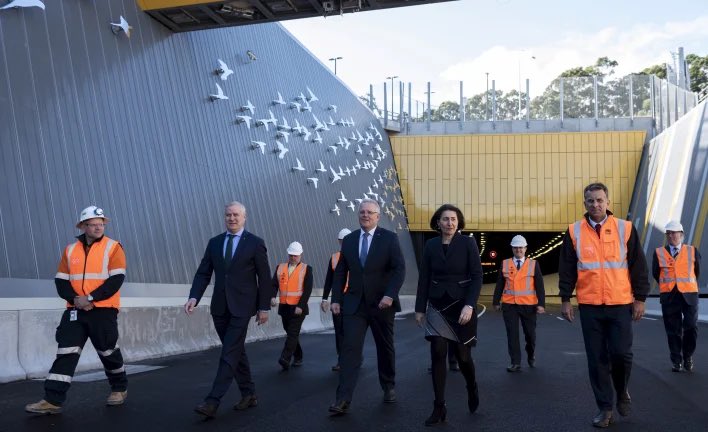
Imagine that money being used to develop new models of decentralised work, people working from home, neighbourhoods strengthened so that they’re no longer just overnight carparks for commuting workers. /2
Conservative governments love transport projects. We don’t often question why, everybody seems to share the assumption that it’s normal for people to need to move so extensively every day. Meanwhile our living spaces outside major transport hubs wither on the vine. /3
They love these projects because ‘business’, rarely defined, is really the process of gradually stripping away all territorial boundaries, to facilitate the free movement of goods and people. This leads to incredibly fragile social environments…/4
… where the basic supply of everyday goods and services requires just-in-time supply chains, ferrying along these transport routes. Any interruption to these routes means that people become unable to do basic things like eat or buy other groceries. /5
At the same time work itself has become more fragile, the gig economy. Workers not only commute to their work every day, that work itself - their job – can change from one day to the next. /6
Not only do households rely upon fragile supply chains, keeping little in reserve for emergencies, but financially they also have increasingly less capacity to stop work in an emergency. I’ve Tweeted before that this is I think the actual cause of the pandemic. /7
Those strenuously pushing to get economies reopen again are strengthening the very mechanism that created the pandemic in the first place. They will stop at nothing to get everything moving again, including killing millions of people and infecting children. /end