30 August
30 August · 19:27 UTC
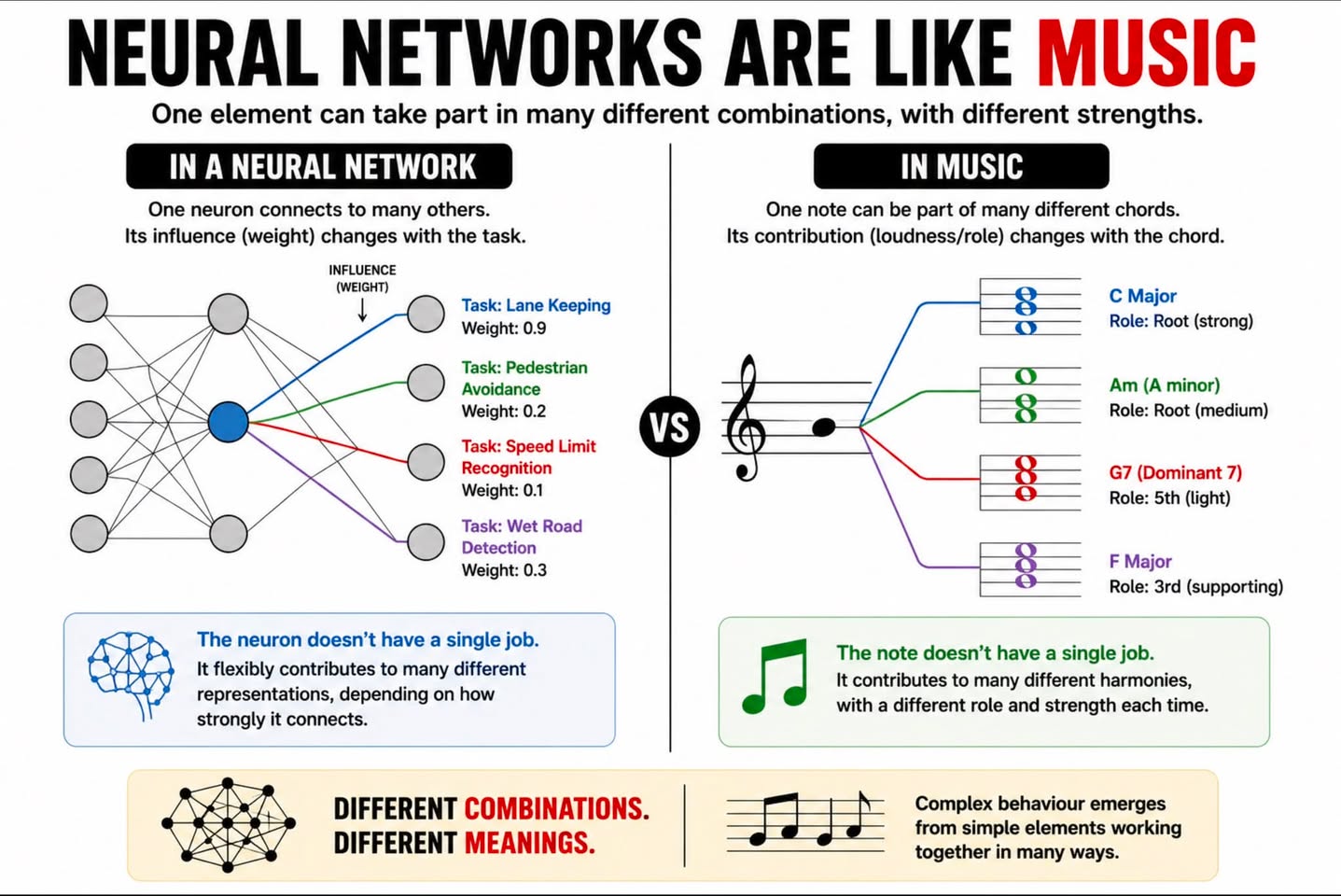
A neural network has nodes, which in our brains (analog AI) are neurons, and in AI (digital AI) are weighted numbers. When our bodies or AI experience the world, these nodes form themselves, nobody pre-programs them. The nodes or weights are the way the network understands its environment, they’re patterns of response. What’s fascinating is that each node can participate in multiple responses. It’s like music, where each note can participate in many harmonies or chords or melodies, while retaining its individuality. And amazingly, this is all that’s needed for thought and consciousness to emerge. Weighted interactions. You don’t program a neural network. It has to learn itself, in interaction with an environment. The network and its nodes are the emergent outcome of that interaction, which is shifting all the time. A network that learns one thing can then change other things it learns, because of all this overlap. When people like Tesla train their self-driving AI, they don’t know in advance how it will respond. It’s genuinely thinking, creating novel solutions to problems. They can alter the training material to try to improve certain things, but the network is a living process of constant learning. The payoff is huge. If you tried to program in all the behaviours you wanted, you’d be writing infinite lines of software. It would never work. But once the neural network is functioning, it’s able to generate completely novel solutions to things it’s never encountered before. Thus ‘generative’ AI.