16 July
16 July · 19:23 UTC
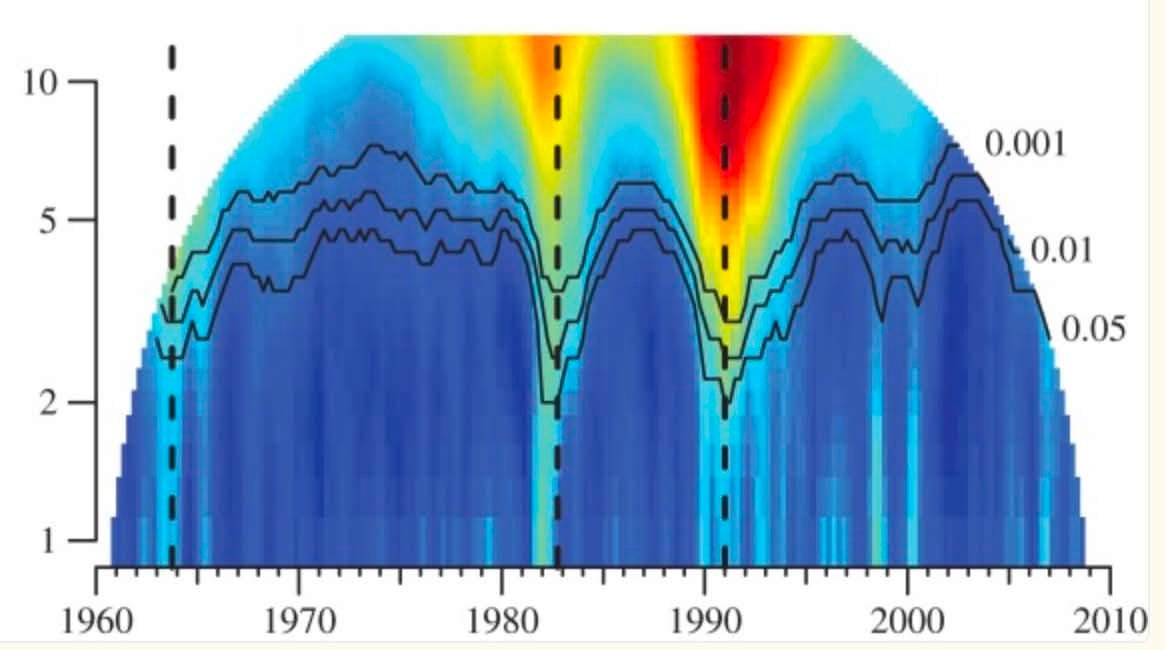
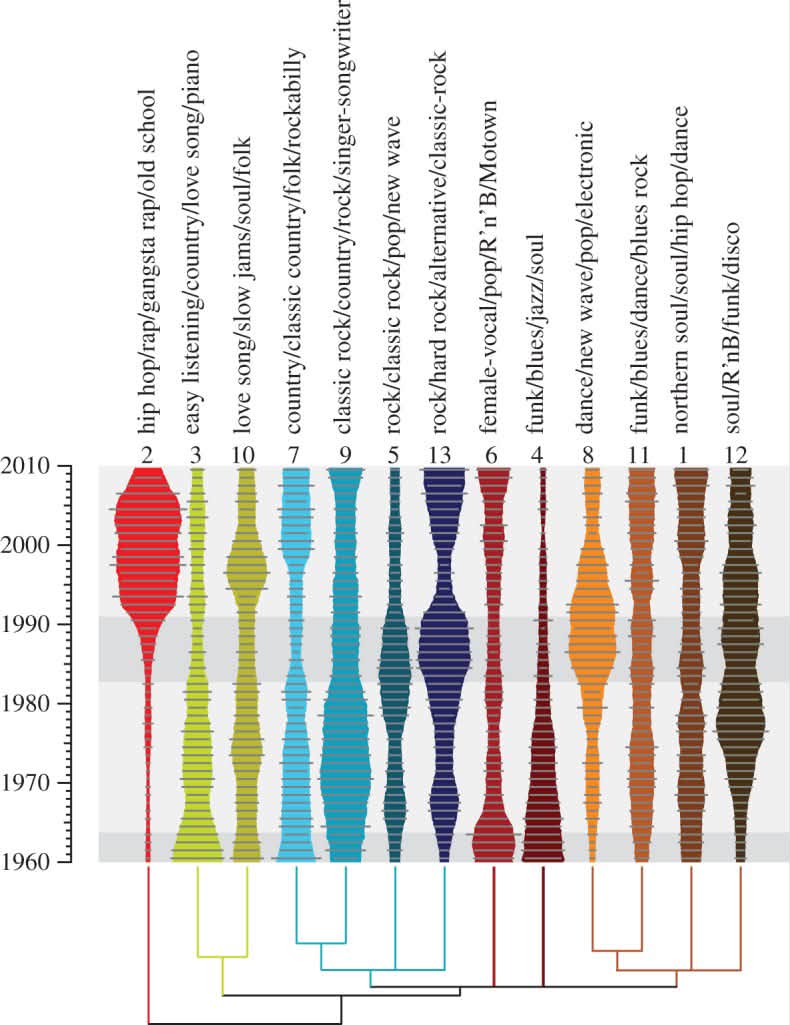
I talk a lot about how human existence is people imitating one another, driven by a battle for social status. We imitate to become part of some social group, to recognise other group members. Creating rivalry within that group and between that group and other groups. This is universal. For example it’s been studied for music, where exactly the same pattern appears. Nearly all music is simple copying, with the occasional ‘punctuated’ revolution that shifts the status quo. Just as catastrophes are all that shift social behaviour in other areas. Two fascinating graphs showing this, from a study of over 17,000 songs released between 1960 and 2010. You can clearly see the pattern here, firstly the graph with all the blue. It codes novelty using colour. Blue is where the music is a repeated pattern with little novelty, while increasing novelty is yellow, then brown, then red. For half a century nearly everything is blue, with only occasional ‘crises’ around 1964, 1983 and 1991, which represented a shift due to revolutionary invention by a tiny number of artists. No real ‘creativity’ except for those tiny 3 periods. (Linking to my other post about creativity and technology today, 1964, 1983 and 1991 also corresponded with major technological innovation in music. It was that which injected the majority of the creative disruption.) The second graph shows the evolution of musical styles, and how they again follow the same imitative pattern that any social trend exhibits. Most of the time the style doesn’t trend at all, then it has its burst of ‘viral’ popularity, then it fades again. Some styles experience repeated viral waves. All of it is the same imitative rivalry you see in the evolution of fashion, or political issues, or whatever. Full study here: https://pmc.ncbi.nlm.nih.gov/articles/PMC4453253/