10 April
10 April · 21:00 UTC
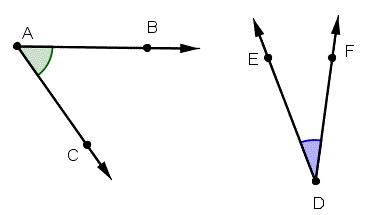
When you study trigonometry at school, you're actually studying deep history. Modern curricula separate maths and history though so you're never told that (hardly anybody even remembers the connection). Angles are the source of all science, and of existence itself. The ancient atomists talk about them all the time, but we forgot why for thousands of years. Why were the ancients obsessed with angles? Yes to help them measure, like the height of pyramids and other things. But that came later, and trigonometry uses angles without really ever understanding them. The angle itself is almost impossible to define, we use trig to give it a number or measured size, as in the diagrams shown we can use the lengths of sides to give angles a size or number. But that's not the essence of the angle itself. The angle is pure deviation. That's why the ancients made them the heart of both their science and their humanities, and of existence. The deviation at the heart of all things, what introduces novelty to the world, all by itself. You can see how this flowed into their ideas about atoms. The smallest possible angle is a tangent. It was in studying this smallest possible angle that a tangent creates with another line that they started to understand the infinitesimal, or atoms. And from which differentiation and integration were born, in mathematics. This is also why the vortex or vortices were the heart of ancient sciences and which again we mostly forgot. Vortices are what are born from that initial deviation, of the angle. Even in the 19th century vortices survived in atomic theory, there were models of the atom as a vortex. Today race car designers and aeronautical engineers, amongst many others, still grapple with vortices. We think we've become cleverer since that earlier time, but I doubt it, we've forgotten much more than we've discovered. And tragically many of the major works of that early time haven't survived.