17 August
17 August · 21:33 UTC
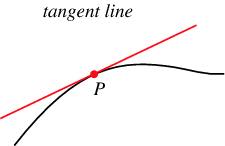
It was angles that led the ancient Greeks to invent the idea of atoms. You know those questions you sometimes ask as a kid, about the infinitely big and infinitely small, like if the universe ends at this point, what's beyond that point? Or if you keep cutting something up, do you ever get to a smallest bit? You can think about that stuff all day and not come up with an answer, but the Greeks realised there was a very practical example of it right in front of them. The tangent. A tangent is the smallest angle possible. Defined as the angle between a straight line just touching a curve, and the curve, as in the picture. Something we all drew in high school, probably without guessing that it was the root of a lot of our science. You can draw it, but you can't calculate that angle, because it's infinitely close to the slope of the curve - the closer you get to it, the more it disappears in a puff of slope in front of you. It was that impossible tension between something you could easily draw but which couldn't be measured or analysed that drove the Greeks to invent the idea of the infinitesimal, and atoms. But their atoms weren't like the little balls you learned about in school, they were vortices, angles constantly changing and undefinable. We still haven't come back to that linking of maths to the real world in that way, we've forgotten a lot of that wisdom.